Brand Strategy Series™
By Narendra Kumar Chaurasia
Creator, Executive Reputation Systems™ (ERS™) | Co-Founder, CreatorBazaar AI Films
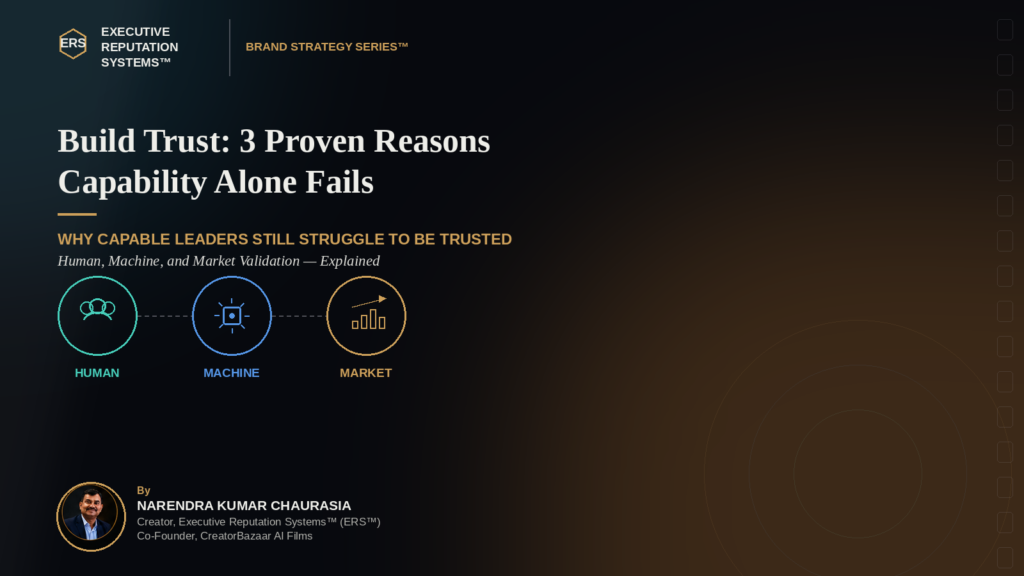
| In this article: Most capable leaders assume that doing good work is enough to build trust. It isn’t. This article lays out three proven, evidence-informed reasons why capability alone fails to build trust — and what CEOs, founders, and senior managers, in India and globally, can do differently. |
Table of Contents
Table of Contents………………………………………………………………………………………………………………………… 1
Executive Summary…………………………………………………………………………………………………………………….. 1
1. Why “Just Do Good Work” Is Not a Trust Strategy……………………………………………………………….. 1
2. Reason 1 — Capability Is Invisible Until Someone Vouches for It…………………………………………… 1
3. Reason 2 — Digital Systems Now Build Trust Before People Do…………………………………………….. 1
4. Reason 3 — The Market Rewards Recognised Capability, Not Just Real Capability……………… 1
5. Why These Three Reasons Compound Each Other…………………………………………………………………. 1
6. An Illustrative Example: A Capable Founder, an Invisible Company…………………………………….. 1
7. What This Means in Practice…………………………………………………………………………………………………… 1
8. What This Is Not……………………………………………………………………………………………………………………… 1
9. Where This Goes Next……………………………………………………………………………………………………………… 1
References & Further Reading……………………………………………………………………………………………………. 1
About the Author………………………………………………………………………………………………………………………… 1
Applied Practice — Work With Us……………………………………………………………………………………………… 1
Executive Summary
Ask most senior leaders how they build trust, and the answer is some version of: “We do good work, and the results speak for themselves.” It’s a reasonable instinct. It’s also, on its own, an incomplete strategy.
Capability and trust are not the same thing, and they don’t automatically convert into each other. A CEO can run a well-managed, profitable company and still struggle to build trust with a new investor. A senior manager can be technically excellent and still not be the person their team turns to under pressure. A founder can build something genuinely good and still watch a competitor with a weaker product win the deal — because the competitor was better at helping the market believe in them.
This article sets out three specific, evidence-informed reasons why leaders who rely on capability alone struggle to build trust — and connects each one to the Three-Validation Architecture within Executive Reputation Systems™ (ERS™), a framework currently in active development and field-testing with executives and founders.
1. Build Trust: Why “Just Do Good Work” Is Not Enough
There’s a quiet assumption embedded in how most leaders — especially technically strong ones — approach their careers: if the work is good enough, recognition will follow, and trust will build itself.
This assumption holds up reasonably well early in a career, when a small number of people directly observe the work. It breaks down as responsibility grows, because the number of people who need to trust a leader — investors, boards, employees, partners, regulators, the market — grows faster than any leader’s ability to personally demonstrate capability to each of them.
At that point, the question stops being “is the work good?” and becomes something harder: how does capability that most people will never directly witness get converted into something they trust anyway? That conversion doesn’t happen automatically. It has specific, identifiable failure points — and understanding them is the first step to build trust deliberately, rather than hoping it happens as a byproduct of good work.
2. Build Trust: Capability Is Invisible Until Someone Vouches for It
The first reason leaders fail to build trust is the simplest: most capability is never directly observed by the people whose trust matters most.
A board member doesn’t watch a CEO work through a difficult operational decision. An investor doesn’t sit in on the meetings where a founder handles a crisis well. A prospective client doesn’t see the quiet, competent decisions that kept a project on track. What they see instead is a compressed, secondhand signal — a reference, a reputation, a confident answer in a single meeting.
This is the Human Validation layer within the ERS framework: the extent to which people who matter actually recognise and trust demonstrated capability, based on credibility, expertise recognition, leadership trust, and thought leadership. When this layer is weak, it’s rarely because the capability is missing. It’s because nobody has translated that capability into something a stranger can trust secondhand — a clear track record, a credible reference, a habit of explaining decisions rather than just making them well.
Leaders who build trust deliberately treat this translation as real work, not an afterthought.
3. Reason 2 — Digital Systems Now Build Trust Before People Do
The second reason is newer, and most leaders — including highly capable ones — have not adjusted to it yet: a meaningful share of first impressions now happen before any human conversation, through a search engine or an AI system.
An investor evaluating a founder will often search their name before the first call. A potential partner will ask an AI assistant what it knows about a company’s leadership before responding to an outreach email. A journalist researching a feature will check what’s publicly, digitally available long before requesting an interview.
This is Machine Validation — whether search engines and AI systems can accurately discover, understand, and represent who a leader is and why their expertise is credible. It rests on discoverability, entity clarity, knowledge consistency, and authority evidence. A capable leader with a thin or outdated digital footprint is, in a very literal sense, failing to build trust with an audience they will never get to meet in person, because that audience already formed a view before the meeting was even scheduled.
This is not about manufacturing a favourable digital image. It’s about ensuring there’s enough accurate, consistent evidence online for these systems to represent real capability correctly — rather than leaving that first impression to whatever fragments happen to be indexed.
4. Reason 3 — The Market Rewards Recognised Capability, Not Just Real Capability
The third reason is the one leaders find hardest to accept: markets, investors, and industries reward capability that has been externally recognised — through relationships, visibility, and demonstrated outcomes — more consistently than they reward capability that simply exists.
This is Market Validation: whether there is credible external evidence — professional recognition, strategic relationships, demonstrated impact — that substantiates a leader’s capability. Two founders can have comparably strong businesses, and the one who has been quoted in the right places, sits on the right panels, or is known within the right professional circles will consistently find it easier to build trust with new stakeholders, even before those stakeholders examine the actual numbers.
This can feel unfair to a leader who has focused entirely on building something real. It is also, empirically, how markets tend to behave — trust is allocated partly on evidence of relevance and recognition, not purely on private knowledge of quality. Leaders who ignore this layer are not being modest. They are leaving a real, measurable gap between their capability and their ability to build trust at the scale their ambitions require.
5. Why These Three Reasons Compound Each Other
None of these three reasons operates in isolation, and that’s what makes the problem harder to see from the inside.
A leader with strong Human Validation — people who work closely with them trust them completely — but weak Machine Validation will still lose ground with anyone who researches them before meeting them. A leader with strong Market Validation — well recognised externally — but weak Human Validation internally may build trust with outsiders that their own team doesn’t fully share, which eventually shows.
The leaders who build trust most durably are rarely the most capable in the room. They are the ones whose capability has been made visible, evidenced, and recognisable across all three environments at once — not by accident, but by consistent, deliberate effort to build trust in each one.
6. An Illustrative Example: A Capable Founder, an Invisible Company
Consider a hypothetical but familiar situation, relevant to many mid-size Indian businesses: a founder in Pune has built a genuinely well-run precision components export business over twelve years — strong client retention, healthy margins, a loyal, skilled team.
Within the company, Human Validation is strong. Employees trust the founder’s judgment; long-standing clients renew without much persuasion. But a search of the founder’s name returns almost nothing — no interviews, no articles, no clear digital trail connecting them to the business’s real achievements. Machine Validation is nearly absent. And within the broader industry, despite genuine export success, the company remains largely unknown outside its existing client base — invited to none of the panels, associations, or recognitions that a business of its quality might reasonably expect. Market Validation lags far behind reality.
When a private equity fund began evaluating acquisition targets in the sector, this business didn’t make the initial shortlist — not because the fundamentals were weaker than competitors, but because there was almost nothing to find. A capable, well-run company failed to build trust with an audience it never even knew was looking, simply because the capability had never been made externally legible.
This example is illustrative, not a documented case study — offered to make the three validation environments concrete, not to prove the framework works in every case.
7. What This Means in Practice
For a CEO, founder, or senior manager who wants to build trust deliberately rather than hope for it, three questions are worth sitting with honestly:
1. Human Validation — If a new stakeholder asked three people who work closely with me to describe my judgment, would their answers be consistent, specific, and credible?
2. Machine Validation — If someone searched my name or my company today, would what they find accurately represent the capability that actually exists?
3. Market Validation — Is there external, visible evidence — recognition, relationships, documented impact — that substantiates what I’ve built, or does it exist only inside the company?
A leader who can answer all three honestly, with real evidence rather than assumption, is in a genuinely strong position. Most leaders, when they ask these questions seriously for the first time, find at least one gap they hadn’t been tracking.
8. What This Is Not
It’s worth being precise about what this argument is not saying, because the line between building trust and manufacturing an image matters.
This is not a case for exaggeration, image management divorced from substance, or chasing visibility for its own sake. The starting assumption throughout is that the capability is real. The failure being described is not a lack of capability — it’s a failure to make real capability legible to the people, systems, and markets that need to trust it. Strengthening Human, Machine, and Market Validation only works, and only holds up over time, when there is genuine capability underneath it.
This framework — the Three-Validation Architecture within Executive Reputation Systems™ (ERS™) — is also still in active development and field-testing through direct conversations with executives and founders. It is offered here as a working perspective, not a finished, independently validated methodology.
9. Where This Goes Next
The practical next step for any leader reading this is not to add three new initiatives to an already full calendar. It’s to identify, honestly, which single validation gap — Human, Machine, or Market — is furthest behind current capability, and start there. Each of these gaps, addressed deliberately, is how leaders build trust that lasts beyond a single deal or a single hire.
The broader question this series will keep returning to is a simple one: capability that isn’t recognised doesn’t disappear, but its value to a leader’s career, company, and credibility stays locked up until someone deliberately works to build trust around it. Leaders who understand this stop waiting for trust to arrive on its own — they build trust the same way they built the capability in the first place: deliberately, and over time.
Related Reading
Before exploring the practical application, you may also find these related articles useful:
The Strategic Reputation Gap Leaders Rarely Measure
7 Powerful Reasons Corporate Films Fail to Build Trust
Executive Influence: What Twenty-Five Years of Being Underestimated Taught Me About Leadership
Executive Branding: 5 Bold Ways AI Visuals Change It
Build Trust: 3 Proven Reasons Capability Alone Fails
Executive Credibility: 5 Costly LinkedIn Mistakes
References & Further Reading
1. Freeman, R. Edward. Strategic Management: A Stakeholder Approach. Foundational work on stakeholder theory and how organisations build trust with the groups connected to them.
2. McKinsey & Company — “Digital trust: Why it matters for businesses” — global survey of 1,333 senior executives (including CEOs) across 20 countries on how digital trust affects business performance.
3. Gallup — “Why Trust in Leaders Is Faltering and How to Gain It Back” — large-scale workplace research on how leaders build and lose employee trust.
4. Edelman Trust Barometer — annual global research on how institutional and leadership trust is built and distributed.
5. Harvard Business Review — ongoing research on leadership credibility and organisational trust.
About the Author
Narendra Kumar Chaurasia is the creator of Executive Reputation Systems™ (ERS™), a framework examining how executives and founders build trust across human, digital, and market environments. He has spent 25+ years in sales, marketing, and business growth, and is Co-Founder of CreatorBazaar AI Films.
Connect:
LinkedIn (Personal): linkedin.com/in/narendra-kumar-chaurasia-768209233
(Company): linkedin.com/company/cinemotion-ai-studio
Website: creatorbazaarglobal.com
Email: contact@creatorbazaarglobal.com
Applied Practice — Work With Us
At CreatorBazaar AI Films, we help capable leaders build trust across all three environments — through AI-powered storytelling designed around a Three-Validation diagnosis, not a generic content calendar.
Want to know which validation gap is costing you the most right now? Get in touch with CreatorBazaar AI Films
Comments
[…] Whether this pattern holds up across real executives — and how often — is an open question that the current field-testing phase is intended to explore, not one this example answers.Related ReadingBefore exploring the practical application, you may also find these related articles useful:7 Powerful Reasons Corporate Films Fail to Build TrustBuild Trust: 3 Proven Reasons Capability Alone Fails […]