How Capability Becomes Recognition — Introducing the Three-Validation Architecture
Executive Reputation Systems (ERS) — Brand Strategy Series
By Narendra Kumar Chaurasia
Creator, Executive Reputation Systems (ERS) | AI Corporate Filmmaker | Co-Founder, CreatorBazaar AI Films | Helping CEOs & Founders Build Trust Through Storytelling
In this article: A framework for understanding why an executive’s real capability doesn’t always translate into recognition — and a first look at the Three-Validation Architecture (Human, Machine, Market) at the core of Executive Reputation Systems (ERS).
Note: ERS is a conceptual framework currently in development and early field-testing. It is presented here as a strategic perspective for discussion, not as a peer-reviewed or independently validated methodology.
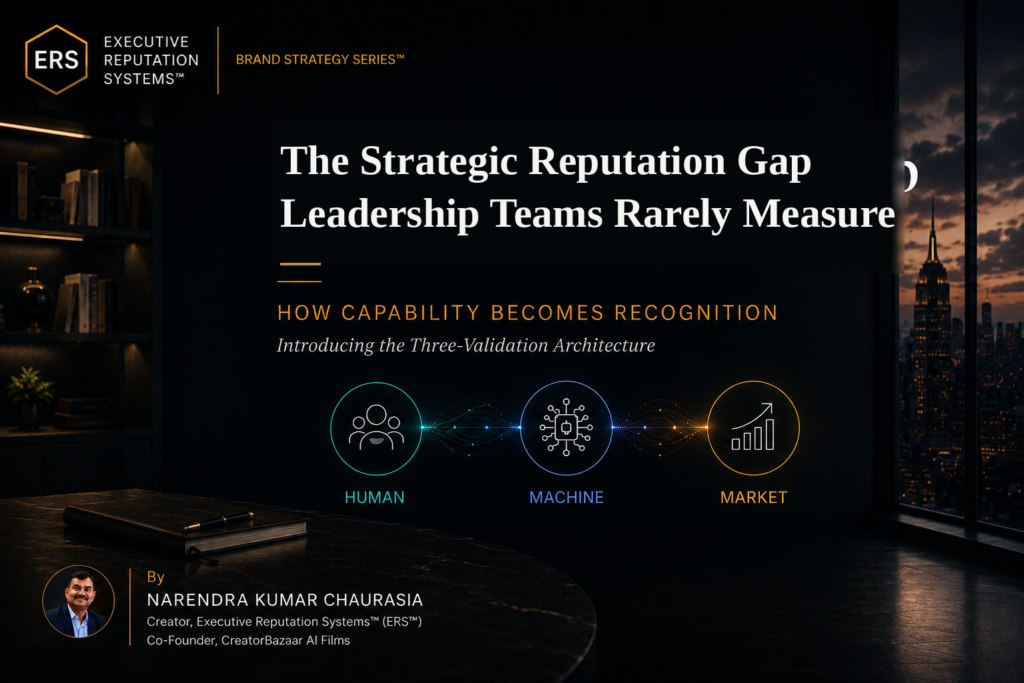
Table of Contents
1. Why This Question Matters Now
2. The Core Problem: Capability Is Not Self-Explaining
3. The Three-Validation Architecture
4. Why a Gap in One Layer Can Undermine the Others
5. What This Is Not
6. An Illustrative (Hypothetical) Example
7. Where This Goes Next
8. References & Further Reading
9. About the Author
Executive Summary
Most leadership teams measure what they build with real discipline — revenue, operational efficiency, product quality, talent capability. Far fewer measure something equally consequential: whether that capability is actually recognised by the people, systems, and markets that decide an executive’s influence.
A leader can be genuinely capable and still be poorly understood. A company can out-execute its competitors and still be seen through an outdated lens. In the Intelligence Era, this gap — between what a leader is and what the world understands them to be — has become harder to ignore, because recognition today runs through three distinct environments at once: the people around a leader, the digital and AI systems that represent them, and the market that evaluates them.
This article introduces the working model behind that idea: the Three-Validation Architecture, the core analytical framework within Executive Reputation Systems (ERS).
A note on where this stands: ERS does not claim to be the first work to examine reputation, trust, or stakeholder perception — those are well-established, decades-old areas of research. What it proposes is a specific way of integrating three validation environments that are usually studied separately, and a disciplined way of identifying where they diverge.
This is an early-stage conceptual model, currently being tested through direct conversations with executives and founders — not a finished or empirically validated instrument.
1. Why This Question Matters Now
Traditional leadership strategy asks:
“Are we executing the right strategy?”
That question remains essential. But it no longer stands alone. Alongside it sits a second, newer question:
“Do the people, systems, and markets around us actually understand the capability we’ve built?”
This isn’t a communications afterthought — it’s a strategic one.
Executive Reputation Systems (ERS) provides a structured way to understand and manage this strategic challenge.
Every leadership decision today creates a signal. Investors read it. Employees interpret it. Search engines and AI systems index it. Competitors and partners factor it into how seriously they take you.
A decision that is sound in substance can still be misread if the surrounding signal is weak, inconsistent, or absent.
This idea builds on long-standing work in stakeholder theory (Freeman, 1984), which holds that an organisation’s success depends on how it is understood and valued by the full range of groups connected to it, not only its shareholders.
Executives have spent decades building capability. Far fewer have built a deliberate system for ensuring that capability is understood.
2. The Core Problem: Capability Is Not Self-Explaining
Many executives possess substantial experience, sound judgment, and real leadership capability — yet that capability does not automatically translate into recognised reputation or strategic influence.
This gap shows up in familiar, specific ways:
- An achievement goes largely unnoticed outside the organisation.
- A Google search returns outdated or incomplete information about a leader who has since evolved considerably.
- A capable executive is known for one narrow thing, while their broader expertise stays invisible to the market.
- A significant opportunity — a partnership, a board seat, a media feature — quietly stalls, possibly because the other side never fully grasped the executive’s actual capability.
These often look less like communication failures in the traditional PR sense, and more like validation gaps — places where demonstrated capability and external recognition have drifted apart.
Global research such as the Edelman Trust Barometer has tracked, year over year, patterns in institutional and leadership trust — broadly relevant to the wider context in which reputation and stakeholder perceptions operate. The Barometer itself does not measure or validate the specific claims of the “Executive Reputation Systems (ERS) framework”.
3. The Three-Validation Architecture
Executive Reputation Systems (ERS) proposes that executive reputation is not built in one environment — it is built, tested, and either reinforced or undermined across three interconnected environments simultaneously.
Within Executive Reputation Systems, these three environments provide a structured lens for examining how demonstrated capability is recognised across human, digital, and market contexts.
Working Conceptual Sequence
Demonstrated Capability → Human + Machine + Market Validation → Trusted Reputation → Strategic Influence
This sequence is a proposed way of organising the idea, not a proven causal chain. The direction and strength of these relationships is exactly what current field-testing is intended to examine — readers should treat it as a hypothesis, not a finding.

Human Validation
Do the people who matter recognise and trust the executive’s demonstrated capability?
This is the most familiar layer — credibility with employees, investors, peers, and partners.
Credibility | Expertise Recognition | Leadership Trust | Thought Leadership
It is built through direct experience and evidence, not claims.
Machine Validation
Can intelligent systems — search engines, AI tools, digital knowledge platforms — accurately discover, understand, and represent who this executive is?
This is the layer most leadership teams have not yet thought about deliberately.
When someone searches an executive’s name, or asks an AI assistant about their expertise, what comes back? Is it current, consistent, and attributable — or outdated, thin, and contradictory?
To be clear: Machine Validation does not mean engineering an AI system to say favourable things. It means ensuring there is sufficient, accurate, and consistent evidence for these systems to represent an executive’s real capability correctly.
Discoverability | Entity Clarity | Knowledge Consistency | Authority Evidence
Market Validation
Does the market provide credible evidence that this capability is recognised, relevant, and influential?
This looks outward — to industry relevance, professional recognition, strategic relationships, and demonstrated impact.
It examines whether an executive’s capability is accompanied by observable signals of relevance, recognition, relationships, and demonstrated impact — not whether one causes the other.
4. Why a Gap in One Layer Can Undermine the Others
These three environments do not operate independently — they reinforce or expose each other.
An executive can have strong Human Validation — people who work with them trust them completely — and weak Machine Validation, where a search of their name returns almost nothing current.
In the Intelligence Era, a due-diligence process, a journalist, or an AI-assisted evaluation may encounter the executive’s digital footprint before any direct interaction takes place.
Equally, an executive can have strong Market Validation — visible achievements and industry recognition — but if Human Validation inside their own organisation is weak, that external reputation may rest on less stable foundations.
The point of the architecture is not to declare one environment more important than the others.
It is to make the combination visible, because leaders and organisations may otherwise examine these environments separately.
5. What This Is Not
It is worth being explicit about what the Three-Validation Architecture does not claim to be:
- Not a manufactured-image exercise. The working principle is that reputation should strengthen alignment with demonstrated reality, not create a version of an executive that outpaces the substance behind it.
- Not yet an empirically validated measurement instrument. The current working model — twelve dimensions across three environments — has not been tested for statistical reliability or validity. It is being explored through qualitative conversations with executives and founders and will be revised based on what that exploration shows.
- Not the first framework to touch on reputation, stakeholder trust, or digital identity. Those are established fields. What ERS proposes is a specific integration of three environments and a way of examining where they diverge — a proposition that remains open to revision as evidence accumulates.
6. An Illustrative (Hypothetical) Example
The following is a composite, hypothetical scenario created to make the three environments concrete. It is not a documented case study, and no specific individual or company is being described.
Consider a hypothetical manufacturing-company CEO who took over from a founder-parent a decade ago and has since rebuilt the business — new export markets, modernised operations, a reputation among employees for sound judgment.
Inside the company, Human Validation is strong: people who work with this CEO trust their decisions.
But a search of their name online surfaces little beyond old news of the succession — Machine Validation is thin.
And in the wider industry, they are still mostly known as “the person who took over the family business,” not for what they have actually built since — Market Validation lags behind reality.
None of these three gaps is dramatic on its own.
Together, they illustrate how a genuinely capable leader could be under-recognised — by investors evaluating a partnership, by journalists researching a feature, or by an AI system asked to summarise who this person is.
Whether this pattern holds up across real executives — and how often — is an open question that the current field-testing phase is intended to explore, not one this example answers.
Related Reading
Before exploring the practical application, you may also find these related articles useful:
7 Powerful Reasons Corporate Films Fail to Build Trust
Build Trust: 3 Proven Reasons Capability Alone Fails
Executive Influence: What Twenty-Five Years of Being Underestimated Taught Me About Leadership
Executive Branding: 5 Bold Ways AI Visuals Change It
Executive Credibility: 5 Costly LinkedIn Mistakes
7. Where This Goes Next
The next stage for Executive Reputation Systems (ERS) is not to add more concepts. It is to test the ones that exist against real executive experience.
Executive Reputation Systems (ERS) provides a working framework for examining these gaps across Human Validation, Machine Validation, and Market Validation.
That means direct, qualitative conversations with CEOs, founders, and senior leaders — asking, in their own words, whether they experience these gaps, where they feel them most, and whether this framework captures something existing approaches miss.
Early findings will refine the working dimensions; some may not survive contact with real evidence, and that is the expected, healthy outcome of testing a new idea honestly.
Future updates to Executive Reputation Systems will report what that testing finds, including where the framework did not hold.
The underlying question leadership teams are invited to sit with is a simple one:
Is the world’s understanding of your capability keeping pace with the capability itself?
References & Further Reading
This article draws on established research in strategy, leadership, and stakeholder trust. It does not claim these sources validate the ERS framework itself — that validation is the subject of ERS’s ongoing field-testing.
- Freeman, R. E. (1984). Strategic Management: A Stakeholder Approach. Boston: Pitman Publishing. — Foundational work on stakeholder theory.
- Edelman Trust Barometer. Global Report. Edelman. — Ongoing global research examining patterns of institutional trust.
- Porter, M. E. (1980). Competitive Strategy: Techniques for Analyzing Industries and Competitors. New York: Free Press. — Foundational work on strategic positioning.
About the Author
Narendra Kumar Chaurasia is the creator of Executive Reputation Systems (ERS), a framework in active development examining how executive capability is recognised across human, digital, and market environments.
He is an AI Corporate Filmmaker and Co-Founder of CreatorBazaar AI Films, helping CEOs and founders build trust through storytelling.
Connect:
LinkedIn: linkedin.com/in/narendra-kumar-chaurasia-768209233
Website: creatorbazaarglobal.com
Email: contact@creatorbazaarglobal.com
Executive Reputation Systems (ERS) is an original framework currently under active development and field-testing. It should be read as a strategic perspective, alongside established research in stakeholder theory, reputation management, and organisational trust — not as a finished, independently validated methodology.
APPLIED PRACTICE — COMMERCIAL DISCLOSURE
Disclosure: The section below describes commercial services offered by the author’s company, CreatorBazaar AI Films. It is included as applied context and is separate from the framework’s research claims above.
How CreatorBazaar AI Films Applies This
At CreatorBazaar AI Films, the Three-Validation Architecture is used as a diagnostic starting point before creative work begins.
Before proposing a deliverable, the first question is:
Which of the three environments — Human, Machine, or Market — is furthest behind this leader’s demonstrated capability?
That diagnosis helps shape the direction of the work:
- A Machine Validation gap may point toward structured digital content and consistent, verifiable executive profiles designed to help improve the clarity of an executive’s digital presence.
- A Human Validation gap may point toward corporate films and leadership storytelling designed to communicate with employees, investors, or partners.
- A Market Validation gap may point toward content designed to support industry visibility, professional recognition, and strategic relationships.
AI-powered corporate filmmaking is one tool among several used to support leadership storytelling and corporate narrative development.
The starting point, though, is always the diagnosis, not the format.
Interested in exploring a Three-Validation diagnostic for your leadership visibility?
Get in touch with CreatorBazaar AI Films.
contact@creatorbazaarglobal.com
exe.ranbaxy@gmail.com
Comments
Very valuable content
It’s very relevant & easy way to understand topic…
Executive Reputation Systems (ERS) presents an interesting foundation built around Human, Machine, and Market Validation. The concept offers a fresh perspective on how executive reputation is formed across these three interconnected dimensions. While still in development, Executive Reputation Systems (ERS) has the potential to become a valuable strategic framework if it continues to be refined, researched, and validated through real-world application.
Executive Reputation Systems (ERS) offers a fresh perspective by connecting Human, Machine, and Market validation. A thoughtful framework with strong potential that could become highly valuable as it evolves through research and practical implementation.
Executive Reputation Systems (ERS) offers a fresh and thoughtful perspective on leadership recognition, with strong potential for meaningful real-world application.
The Human, Machine, and Market approach provides a strong foundation for understanding modern executive reputation. Though still evolving, I hope Executive Reputation Systems brings fresh thinking and valuable new perspectives to this field.
A thoughtful initiative that brings greater clarity to how leadership capability can gain meaningful recognition.
A thoughtful initiative that brings greater clarity to how leadership capability can gain meaningful recognition.
The Human, Machine, and Market approach provides a strong foundation for understanding modern executive reputation. Though still evolving, I hope Executive Reputation Systems brings fresh thinking and valuable new perspectives to this field.
It’s creating meaningful change in life