Corporate Film Psychology™ Series
By Narendra Kumar Chaurasia, Creator, Executive Reputation Systems™ (ERS™), Co-Founder, CreatorBazaar AI Films
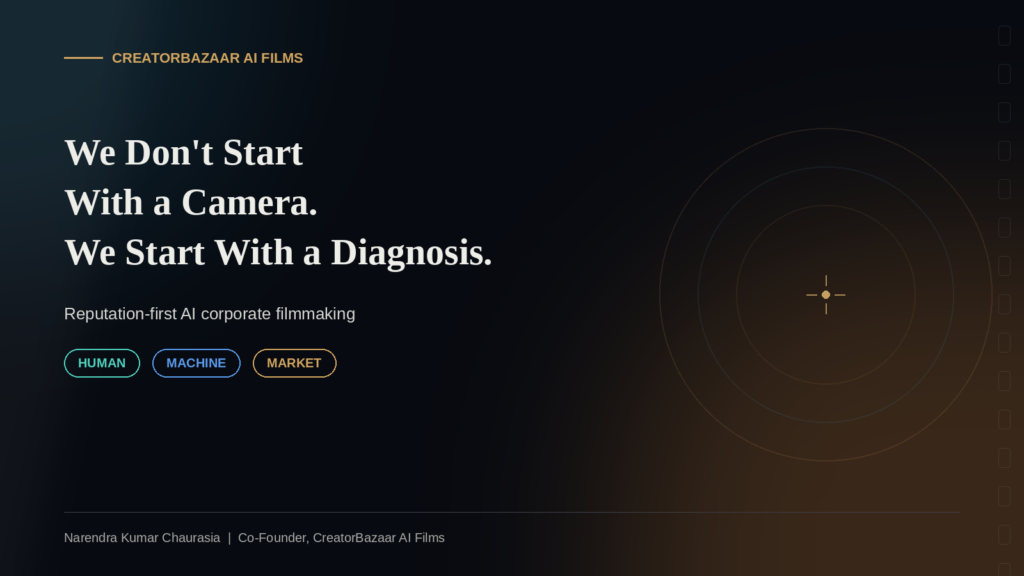
Table of Contents
- The Film Gets Made. The Trust Doesn’t Follow.
- The Camera Is Not the Problem.
- Three Questions Every Corporate Film Should Answer.
- An Illustrative Example: The Right Film, Aimed at the Wrong Gap.
- A Better Way to Think About Corporate Films.
- Applied Practice — Work With Us.
- Corporate Film Psychology™ Series.
In this article: Most corporate films are judged on production quality — lighting, editing, music. Very few are judged on the question that actually determines whether they work: did this change what someone believed about the company or its leader? This piece looks at why that gap exists, and what a film would need to do differently to close it.
The most effective corporate films help businesses build trust, improve credibility, and influence stakeholder decisions.
The Film Gets Made. The Trust Doesn’t Follow.
A company invests in a corporate film. The shoot goes well. The edit looks polished. It gets posted, gets a respectable number of views, gets shared internally with some pride.
Many corporate films fail because they focus on production quality instead of changing audience perception.
Then, mostly, nothing changes.
Investors who were uncertain are still uncertain. Employees who didn’t understand the company’s direction still don’t. The market’s picture of the leader is exactly what it was before the film existed.
This isn’t usually a production problem. The lighting was fine. The editing was fine. The problem sits earlier — in what the film was actually trying to do, and whether anyone was honest about that before the camera came out.
Corporate films should solve trust problems, not just production problems.
Most Corporate Films Are Built to Look Good, Not to Change a Belief
There’s a quiet but important difference between a film that is well-made and a film that builds trust.
A well-made film is judged by: Does it look professional? Is the story engaging? Does it reflect well on the brand?
A trust-building film is judged by something harder to see on a screen: Did the specific person watching this walk away believing something different about the leader or the company than they did before?
Most corporate video briefs start with the first question. Almost none start with the second — because the second question requires knowing, specifically, what the audience currently believes, and where that belief is wrong or incomplete. That’s not a filmmaking task. It’s a diagnostic one, and it usually doesn’t happen.
The Missing Step: Knowing What Gap the Film Is For
Within the Executive Reputation Systems™ (ERS™) framework, reputation gaps tend to show up in one of three places — how people directly experience a leader, how digital and AI systems represent them, and how the market recognises their work. A film aimed at the wrong one of these will look good and still miss.
The most successful corporate films begin with audience diagnosis.
A founder with strong internal trust but a thin, outdated digital footprint doesn’t need an inspirational culture film — they need content built to be discoverable and representative online, the kind of material that gives search engines and AI systems something accurate to work with.
A leader who’s well known in the industry but not trusted internally doesn’t need a slick external brand film — they need something that speaks honestly to their own team.
A capable executive whose work is simply invisible outside their own circle doesn’t need polish at all — they need visibility, in front of the right audience, however plain the production.
Three different problems. Three different films. Most companies skip the diagnosis and make the same kind of film regardless — because “make a corporate video” is a familiar request, and “figure out exactly which trust gap we’re solving for” is not.
Successful corporate films begin with identifying the right reputation gap before production starts.
An Illustrative Example: The Right Film, Aimed at the Wrong Gap
Consider a hypothetical but familiar scenario: a mid-size logistics company brings in a production team for an inspirational “our culture” film — leadership interviews, employee testimonials, an uplifting soundtrack. It’s well shot. Everyone involved is proud of it.
Inside the company, it barely moves anything, because internal trust was never the problem — employees already believed in the leadership. The actual issue was external: when a potential investor or partner searched the founder’s name, almost nothing current came up, and industry peers still associated the company with a service it had phased out two years earlier.
The film addressed a Human Validation question nobody was asking, while the company’s real gap — thin Machine Validation and outdated Market Validation — went untouched. The production was good. The diagnosis was skipped.
This example is illustrative, not a documented case study — it is meant to make the three environments concrete, not to prove the framework works in practice.
Why Polish Alone Doesn’t Persuade
There’s a reasonable assumption behind most corporate video budgets: better production values will be more convincing.
Production quality matters — a poorly made film can undercut a message. But polish and persuasion aren’t the same axis. A beautifully shot film built around the wrong message, or aimed at the wrong audience, doesn’t fail because it looks cheap. It fails because it was never actually about what the viewer needed to know.
This is consistent with a broader idea in stakeholder theory: an audience’s trust depends on whether communication addresses their specific stake in the outcome, not on how well-produced that communication is. A polished film that doesn’t speak to what an investor, employee, or partner actually needs to believe is unlikely to move that belief — regardless of the camera work.
High-quality corporate films are effective only when they support a clear business objective.
What This Looks Like in Practice
A more disciplined approach to a corporate film starts before any script is written, with three plain questions:
- Who, specifically, is this film for — and what do they currently believe that isn’t quite right?
- Which validation gap is this addressing — is it about people trusting the leader more directly, about digital systems representing them accurately, or about the market recognising work it doesn’t yet see?
- What would this audience need to see or hear to actually update that belief — not what would look impressive, but what would be credible to them specifically?
The best corporate films combine strategy, storytelling, and credibility to create measurable business impact.Only after those three questions have honest answers does the actual filmmaking—script, visuals, AI-assisted production, and editing—begin. The format follows the diagnosis, not the other way around. The best corporate films combine strategy, storytelling, and credibility to create measurable business impact. Great corporate films influence perception before they impress viewers.
A Note on Where This Sits
This article is part of an ongoing series exploring the psychology behind corporate storytelling, connected to the broader Executive Reputation Systems™ (ERS™) framework, which is still in active development and field-testing. The observations here are drawn from applied experience in corporate filmmaking and communication, not from a controlled study — they’re offered as a working perspective, open to revision as more evidence comes in.
Related Reading
Before exploring the practical application, you may also find these related articles useful:
The Strategic Reputation Gap Leaders Rarely Measure
Build Trust: 3 Proven Reasons Capability Alone Fails
7 Powerful Reasons Corporate Films Fail to Build Trust
Executive Branding: 5 Bold Ways AI Visuals Change It
Executive Influence: What Twenty-Five Years of Being Underestimated Taught Me About Leadership
Executive Credibility: 5 Costly LinkedIn Mistakes
References & Further Reading
- Freeman, R. Edward. Strategic Management: A Stakeholder Approach. Foundational work on stakeholder theory and audience-specific trust.
- Edelman Trust Barometer — ongoing global research on institutional and leadership trust.
- Harvard Business Review — research on corporate storytelling and organisational communication.
About the Author
Narendra Kumar Chaurasia is the creator of Executive Reputation Systems™ (ERS™) and Co-Founder of CreatorBazaar AI Films, where AI-powered corporate storytelling is built around a reputation-first diagnostic — not production alone.
Connect: LinkedIn (Personal): linkedin.com/in/narendra-kumar-chaurasia-768209233 LinkedIn
(Company): linkedin.com/company/cinemotion-ai-studio
Website: creatorbazaarglobal.com
Email: contact@creatorbazaarglobal.com
APPLIED PRACTICE — WORK WITH US
At CreatorBazaar AI Films, every film brief starts with the same three questions above — before any camera or AI tool is involved. If your last corporate film didn’t move the needle, the format probably wasn’t the problem.
Interested in a reputation-first diagnostic before your next film? Get in touch with CreatorBazaar AI Films.
Comments
[…] ReadingBefore exploring the practical application, you may also find these related articles useful:7 Powerful Reasons Corporate Films Fail to Build TrustBuild Trust: 3 Proven Reasons Capability Alone […]
A great corporate film doesn’t just look professional—it builds trust. The right story starts with understanding the audience, not the camera.
Rightly said