LinkedIn Authority System™ Series
By Narendra Kumar Chaurasia
Creator, Executive Reputation Systems™ (ERS™) | Co-Founder, CreatorBazaar AI Films
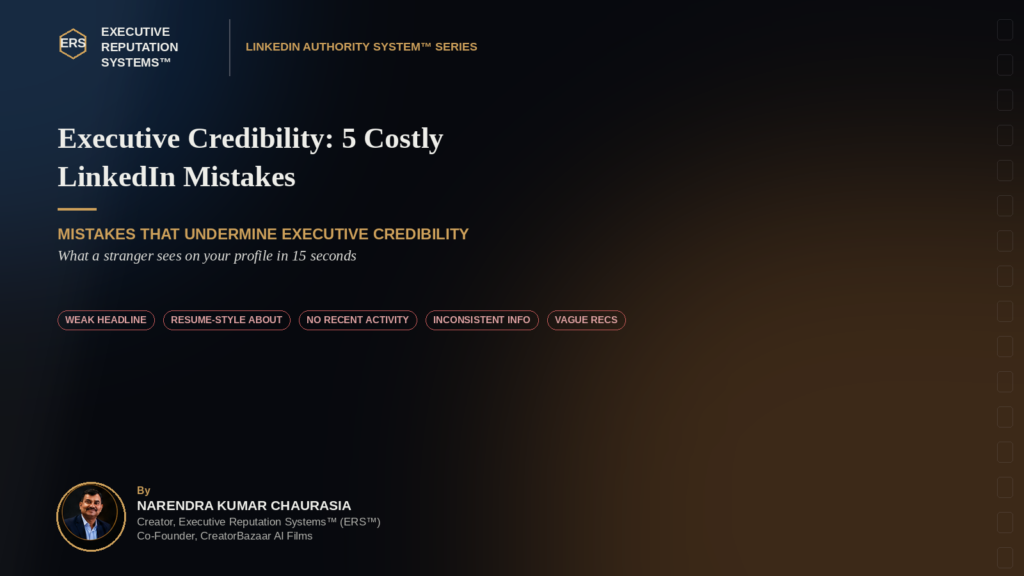
| In this article: For most executives, LinkedIn is the first place a stranger goes to verify who they are. This article looks at five specific, common mistakes on executive LinkedIn profiles that quietly undermine executive credibility — before a single conversation ever happens. |
Table of Contents
Table of Contents………………………………………………………………………………………………………………………… 1
Executive Summary…………………………………………………………………………………………………………………….. 1
1. Why LinkedIn Has Become an Executive Credibility Test………………………………………………………. 1
2. Mistake 1 — A Headline That Describes a Job, Not a Value……………………………………………………. 1
3. Mistake 2 — An About Section Written Like a Resume………………………………………………………….. 1
4. Mistake 3 — No Evidence of Recent Thinking…………………………………………………………………………. 1
5. Mistake 4 — Inconsistent or Outdated Role Information………………………………………………………… 1
6. Mistake 5 — Recommendations That Say Nothing Specific…………………………………………………….. 1
7. Why These Five Mistakes Compound Each Other………………………………………………………………….. 1
8. An Illustrative Example: A Strong Leader, a Weak Profile…………………………………………………….. 1
9. What This Means in Practice…………………………………………………………………………………………………… 1
10. What This Is Not……………………………………………………………………………………………………………………. 1
11. Where This Goes Next……………………………………………………………………………………………………………. 1
References & Further Reading……………………………………………………………………………………………………. 1
About the Author………………………………………………………………………………………………………………………… 1
Executive Summary
Before an investor takes a call, before a journalist responds to a pitch, before a potential partner agrees to a meeting, one thing very often happens first: someone opens a LinkedIn profile. In that moment, executive credibility is being quietly assessed — not through a conversation, but through a page most leaders update rarely and review even less.
This article examines five specific, common mistakes that undermine executive credibility on LinkedIn, drawn from the Human and Machine Validation layers of Executive Reputation Systems™ (ERS™), a framework currently in active development and field-testing with executives and founders.
1. Why LinkedIn Has Become an Executive Credibility Test
LinkedIn has quietly become one of the first places executive credibility is tested, often before a leader is even aware it’s happening. A profile viewed for fifteen seconds before a meeting shapes expectations that the meeting itself then has to either confirm or fight against.
Most executives treat their LinkedIn profile as a formality — filled in once, rarely revisited. That treatment doesn’t match how the profile is actually used by the people evaluating it: as quick, high-stakes evidence of whether this leader’s executive credibility is worth taking seriously.
2. Mistake 1 — A Headline That Describes a Job, Not a Value
The most common mistake is also the most visible: a headline that simply repeats a job title — “CEO at [Company]” — with nothing about what that leadership actually means for the people reading it.
This undermines executive credibility subtly but consistently, because a job title alone tells a stranger almost nothing about judgment, focus, or track record. A headline that says what a leader actually does — the specific value, problem, or capability — gives a reader something concrete to evaluate, rather than a label to skim past.
3. Mistake 2 — An About Section Written Like a Resume
The second mistake is treating the About section as a chronological resume — company names, dates, and titles, in order, with little sense of judgment, priorities, or perspective.
A resume format answers “what roles has this person held.” It doesn’t answer the more important question a stranger is actually asking: “what does this person actually think, and can I trust their judgment.” An About section that includes even a few sentences of genuine perspective — how a leader approaches a problem, what they’ve learned, what they care about — does far more for executive credibility than a longer list of past titles.
4. Mistake 3 — No Evidence of Recent Thinking
The third mistake is silence. A profile with no posts, comments, or activity in the last year gives a visitor nothing current to evaluate — only historical claims, with no way to check whether the thinking behind them is still sharp.
This matters more than most leaders assume, because both people and AI systems increasingly treat recent activity as a signal of relevance. A leader who posted actively three years ago and then went quiet reads, to a careful visitor, as someone who may have become less engaged — whether or not that’s actually true. Recency, even a small amount of it, protects the executive credibility that silence quietly erodes.
5. Mistake 4 — Inconsistent or Outdated Role Information
The fourth mistake is one of the easiest to fix and one of the most commonly ignored: role, company, or achievement information that no longer matches reality, or that’s described differently across different sections of the same profile.
A visitor who notices even a small inconsistency — a former company still listed as current, an achievement described one way in the headline and another way in the About section — doesn’t usually think “simple oversight.” They quietly downgrade trust, because inconsistency reads as carelessness, and carelessness undermines executive credibility faster than almost anything else on the page.
6. Mistake 5 — Recommendations That Say Nothing Specific
The fifth mistake concerns the recommendations section: generic, warm, but non-specific endorsements — “great to work with,” “true professional” — that could describe almost anyone.
Specific recommendations, referencing an actual project, decision, or outcome, do meaningfully more for executive credibility than a larger number of vague ones. A single detailed recommendation describing a real situation is more convincing to a careful reader than five generic ones, because specificity is much harder to fake convincingly than warmth.
7. Why These Five Mistakes Compound Each Other
None of these five mistakes exists in isolation on a real profile. A generic headline combined with a resume-style About section and no recent activity creates a compounding impression: this is a profile maintained out of obligation, not a genuine reflection of an active, engaged leader.
Fixing one mistake in isolation rarely changes the overall impression enough to matter. Executive credibility on LinkedIn tends to shift only when several of these mistakes are addressed together, because visitors form an overall impression of executive credibility, not a checklist score.
8. An Illustrative Example: A Strong Leader, a Weak Profile
Consider a hypothetical CEO of a mid-size Indian logistics company — genuinely capable, well regarded internally, with a strong operating record over a decade.
Their LinkedIn headline reads simply “CEO at [Company].” The About section lists previous roles chronologically, with no perspective on how they think about logistics, growth, or leadership. The last post is from over two years ago. When a potential acquirer’s team did preliminary research before a first call, the profile suggested someone disengaged and possibly coasting — an impression the actual person, in conversation, immediately contradicted. But by then, the first call had already been shaped by a weaker starting impression than the leader’s real capability deserved.
This example is illustrative, not a documented case study — offered to make the cumulative effect of these five mistakes concrete, not to prove the framework works in every case.
9. What This Means in Practice
For a leader reviewing their own profile, five honest questions are worth asking:
1. Headline — Does my headline communicate value, or just repeat my title?
2. About Section — Would a stranger learn how I think, or only what roles I’ve held?
3. Recency — Would a visitor today find evidence I’m actively, currently engaged?
4. Consistency — Does every section of my profile agree with every other section?
5. Recommendations — Do my recommendations describe something specific, or could they describe anyone?
A leader who can answer all five honestly, and fix even two or three of the gaps that surface, will usually see a meaningful shift in how their profile is received. This is rarely a large undertaking — most of these fixes take less time than a single meeting, yet the executive credibility they protect compounds over every future visit to the profile.
It’s worth adding one further practical note: these five fixes work best done together, in one sitting, rather than spread across many small edits over months. A profile updated all at once tends to read as coherent and intentional. A profile patched gradually, section by section, over a long period can end up inconsistent in tone even after every individual mistake has technically been corrected — which is itself one more way executive credibility can quietly erode without anyone noticing exactly why.
10. What This Is Not
It’s worth being precise about what this argument does not claim.
This is not a case for exaggerating achievements, manufacturing activity, or treating LinkedIn as a performance rather than an accurate reflection of real work. Every fix described here only strengthens executive credibility when the underlying capability and judgment are genuinely there — a well-written profile describing capability that doesn’t exist creates a different, more serious problem than the one this article addresses.
This framework, and the broader Executive Reputation Systems™ (ERS™) architecture it connects to, remains in active development and field-testing. The five mistakes described here are offered as a working, evidence-informed perspective, not a finished, independently validated instrument.
11. Where This Goes Next
Most executives will recognise at least two or three of these five mistakes on their own profile without much difficulty. The harder, more useful step is an honest, specific review — not a general sense that “the profile could be better,” but a clear list of exactly what a stranger sees today, and what that stranger reasonably concludes from it.
Want a free 5-minute profile review? Comment below, and I’ll take a genuine look and share what I see.
Related Reading
Before exploring the practical application, you may also find these related articles useful:
The Strategic Reputation Gap Leadership Teams Rarely Measure
7 Powerful Reasons Corporate Films Fail to Build Trust
Build Trust: 3 Proven Reasons Capability Alone Fails
Executive Branding: 5 Bold Ways AI Visuals Change It
Executive Influence: What Twenty-Five Years of Being Underestimated Taught Me About Leadership
Human Validation: 4 Powerful Signals People Need First
References & Further Reading
1. Harvard Business Review — “Begin with Trust,” by Frances Frei and Anne Morriss — foundational research on the specific signals people use to judge trustworthiness.
2. Gallup — “Why Trust in Leaders Is Faltering and How to Gain It Back” — research on how consistency and evidence shape workplace trust.
3. McKinsey & Company — “Digital trust: Why it matters for businesses” — global executive research on digital trust and business outcomes.
About the Author
Narendra Kumar Chaurasia is the creator of Executive Reputation Systems™ (ERS™), a framework examining how executives and founders build trust and Human Validation across human, digital, and market environments. He has spent 25+ years in sales, marketing, and business growth, and is Co-Founder of CreatorBazaar AI Films.
Connect with the Author
CreatorBazaar AI Films – Official Website
https://creatorbazaarglobal.com
Narendra Kumar Chaurasia – LinkedIn
https://www.linkedin.com/in/narendra-kumar-chaurasia-768209233
CreatorBazaar AI Films – LinkedIn Company Page
https://www.linkedin.com/company/cinemotion-ai-studio/?viewAsMember=truehttps://www.linkedin.com/company/cinemotion-ai-studio/?viewAsMember=true
Comments
Very nice
👏🏻👏🏻👏🏻👏🏻