AI Image Architecture™ Series
By Narendra Kumar Chaurasia
Creator, Executive Reputation Systems™ (ERS™) | Co-Founder, CreatorBazaar AI Films
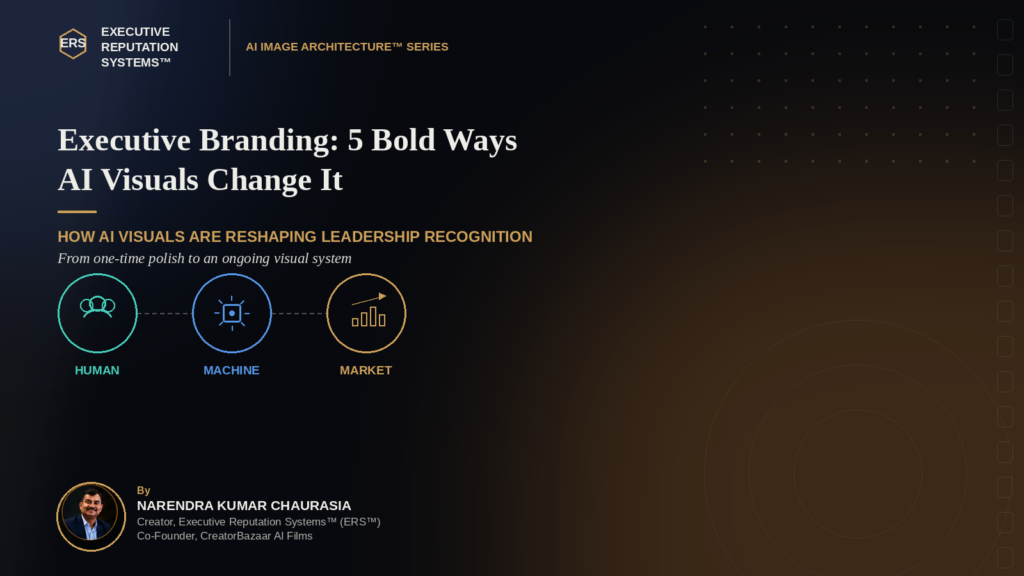
| In this article: Executive branding used to mean a good headshot and a polished bio. AI has quietly rewritten that. This article looks at five specific, evidence-informed ways AI visuals are changing executive branding — and what leaders should understand before they ignore it. |
Table of Contents
Table of Contents………………………………………………………………………………………………………………………… 1
Executive Summary…………………………………………………………………………………………………………………….. 1
1. Why Executive Branding Can No Longer Ignore AI Visuals…………………………………………………… 1
2. Way 1 — Executive Branding Now Has to Work for Machines, Not Just People……………………. 1
3. Way 2 — Consistency Has Replaced Occasional Polish…………………………………………………………… 1
4. Way 3 — AI Visuals Are Compressing the Cost of Looking Credible……………………………………… 1
5. Way 4 — Executive Branding Is Becoming Data, Not Just Image…………………………………………… 1
6. Way 5 — The Risk of Sameness Is Real, and Growing……………………………………………………………. 1
7. An Illustrative Example: Two Founders, Two Visual Strategies……………………………………………… 1
8. What This Means in Practice…………………………………………………………………………………………………… 1
9. What This Is Not……………………………………………………………………………………………………………………… 1
10. Where This Goes Next……………………………………………………………………………………………………………. 1
References & Further Reading……………………………………………………………………………………………………. 1
About the Author………………………………………………………………………………………………………………………… 1
Applied Practice — Work With Us……………………………………………………………………………………………… 1
Executive Summary
For most of the last two decades, executive branding meant a well-lit headshot, a tidy LinkedIn banner, and perhaps a corporate video shot once every few years. It was treated as a one-time asset, not an ongoing system.
That assumption no longer holds. AI-generated and AI-assisted visuals have changed both the volume and the function of executive branding — not by making leaders look better, but by changing who, or what, is actually looking. This article sets out five specific ways this shift is playing out, grounded in the Machine Validation layer of Executive Reputation Systems™ (ERS™), a framework currently in active development and field-testing with executives and founders.
1. Why Executive Branding Can No Longer Ignore AI Visuals
Executive branding has historically been built around a simple assumption: a human being will look at this image, in a specific context — a conference bio, a company website, a press feature — and form a judgment.
That assumption is now only partly true. A meaningful share of the “audience” for executive branding today includes AI systems that crawl, index, and summarise visual and textual content before a human ever sees it. A generative AI tool asked to describe a company’s leadership will draw on whatever visual and textual material is publicly available and consistent. An outdated, inconsistent, or thin visual presence doesn’t just look dated to a person — it gives AI systems less accurate material to work with when representing a leader to someone else.
This is the starting point for understanding why a leader’s public presence, as a discipline, has had to change.
2. Way 1 — Executive Branding Now Has to Work for Machines, Not Just People
The first shift is the most structural: a leader’s public presence is increasingly evaluated by systems before it’s seen by people.
Search engines have long used image metadata, alt text, and surrounding content to understand what an image represents. AI systems go further — synthesising visual presence across multiple sources to form a composite impression of who a leader is. A single polished photo, disconnected from consistent digital context, does less work than it used to.
Executive branding that accounts for this reality treats visuals as structured information, not just aesthetic output — with accurate file names, alt text, and consistent presentation across platforms, so that both people and AI systems arrive at the same accurate impression.
3. Way 2 — Consistency Has Replaced Occasional Polish
The second shift is about frequency, not just quality. A single excellent photo shoot every three years used to be sufficient for executive branding. It no longer is.
AI-assisted visual tools have made it realistic to maintain a consistent visual identity — a recognisable style, tone, and quality — across many pieces of content over time, rather than one high-quality asset surrounded by years of inconsistent or absent material. According to McKinsey’s research on generative AI in marketing, generative tools are already helping organisations generate content and personalise it at a pace and consistency that would have been previously impractical.
For leaders specifically, this shift means those who show up consistently — even modestly — across many touchpoints tend to build stronger recognition than leaders with one excellent asset and long silences in between.
4. Way 3 — AI Visuals Are Compressing the Cost of Looking Credible
The third shift is economic. AI-assisted visual and video production has meaningfully lowered the cost and time required to produce credible executive content — corporate films, structured visual profiles, consistent imagery across platforms.
This matters for leaders because it removes an old excuse: that only large, well-resourced companies could afford to maintain a strong, consistent visual presence for their leadership. A capable founder at a mid-size company can now maintain a level of visual consistency that would previously have required a much larger budget and production team.
The leaders who benefit most from this shift are not necessarily the ones with the biggest budgets — they’re the ones who treat executive branding as a system worth investing in consistently, now that the cost of doing so has dropped.
5. Way 4 — Executive Branding Is Becoming Data, Not Just Image
The fourth shift is conceptual. A leader’s public image used to be evaluated almost entirely on visual and aesthetic terms — does the photo look professional, does the video feel polished. Increasingly, it’s also evaluated as structured, discoverable evidence.
This connects directly to Machine Validation within the ERS framework: whether search engines and AI systems can accurately discover, understand, and represent a leader based on available evidence. A strong visual asset that isn’t accompanied by consistent, accurate surrounding information — correct naming, accurate captions, consistent presentation of role and achievements — does less to build this recognition than a more modest asset that is well-structured and consistent.
In practice, this means executive branding decisions increasingly involve questions that sound more like information architecture than photography: Is this consistently named and described everywhere it appears? Does it connect clearly to the leader’s actual, current role and achievements?
6. Way 5 — The Risk of Sameness Is Real, and Growing
The fifth shift is a genuine risk, not just an opportunity. As AI-assisted visual tools become widely available, there’s a real danger that leadership imagery starts to look generically similar across leaders and companies — the same visual styles, the same generic backdrops, the same polished-but-forgettable tone.
This is worth naming honestly: AI visuals can make a leader’s public presence more consistent and more efficient, but consistency and efficiency are not the same as distinctiveness. Leaders who treat AI-assisted visual tools purely as a shortcut, without a clear point of view about what makes their own executive branding specific and credible, risk becoming visually interchangeable with competitors who used the same tools.
The leaders who use these tools well are the ones who still start with a clear answer to the question: what, specifically, should someone come away believing about me — not just what should this look like.
7. An Illustrative Example: Two Founders, Two Visual Strategies
Consider two hypothetical founders in the same Indian mid-market manufacturing sector, both genuinely capable, both leading similarly sized companies.
The first founder invested in one excellent corporate film three years ago, and little else since. It remains their only strong visual asset — professionally made, but now out of step with the company’s current products, team, and achievements, and disconnected from everything else about them online.
The second founder works with a smaller, ongoing budget for AI-assisted visual content — consistent LinkedIn presence, a structured, accurately captioned digital profile, and short, regularly updated video content. Individually, none of these assets is as polished as the first founder’s single film. Collectively, they build a far stronger, more current, and more discoverable presence — both for people who search for the founder directly, and for AI systems asked to describe them.
This example is illustrative, not a documented case study — offered to make the difference between one-time polish and ongoing executive branding concrete, not to prove the framework works in every case.
8. What This Means in Practice
For a CEO, founder, or senior manager reassessing their own executive branding, three practical questions are worth asking:
1. Consistency — Is my visual presence current, and does it appear consistently across the platforms that matter, or is it built around one asset from several years ago?
2. Structure — Is my visual content accurately named, captioned, and connected to my current role — in a way that both people and AI systems can represent correctly?
3. Distinctiveness — If I used the same AI-assisted tools as my closest competitor, what would still make my executive branding specifically mine?
Leaders who can answer these three honestly are positioned to use AI visuals as a genuine advantage in their executive branding, rather than a generic shortcut.
9. What This Is Not
It’s worth being precise about what this argument does not claim.
This is not a case for replacing genuine substance with visual polish, or for assuming that more AI-generated content automatically improves executive branding. The underlying capability still has to be real — visuals, however well-produced or well-structured, only support Machine Validation; they don’t substitute for Human or Market Validation, which depend on real relationships, real trust, and real demonstrated outcomes.
This article, and the broader Executive Reputation Systems™ (ERS™) framework it connects to, remains in active development and field-testing. The five shifts described here are offered as a working perspective grounded in current evidence, not a finished, independently validated methodology.
10. Where This Goes Next
The practical next step for most leaders is not a full visual overhaul. It’s a honest audit: when was executive branding last updated, how consistent is it across platforms, and how accurately does it represent current, real capability — to people, and increasingly, to the AI systems now standing between a leader and the people who need to trust them.
Related Reading
Before exploring the practical application, you may also find these related articles useful:
Executive Influence: What Twenty-Five Years of Being Underestimated Taught Me About Leadership
Executive Branding: 5 Bold Ways AI Visuals Change It
Build Trust: 3 Proven Reasons Capability Alone Fails
7 Powerful Reasons Corporate Films Fail to Build Trust
The practical next step for most leaders is not a full visual overhaul. It’s a honest audit: when was executive branding last updated, how consistent is it across platforms, and how accurately does it represent current, real capability — to people, and increasingly, to the AI systems now standing between a leader and the people who need to trust them.
Related Reading
Before exploring the practical application, you may also find these related articles useful:
Executive Influence: What Twenty-Five Years of Being Underestimated Taught Me About Leadership
Executive Branding: 5 Bold Ways AI Visuals Change It
Build Trust: 3 Proven Reasons Capability Alone Fails
7 Powerful Reasons Corporate Films Fail
The Strategic Reputation Gap Leadership Teams Rarely Measure
Executive Credibility: 5 Costly LinkedIn Mistakes
References & Further Reading
1. McKinsey & Company — “The power of generative AI for marketing” — analysis of how generative AI is reshaping content production, consistency, and personalisation at scale.
2. McKinsey & Company — “Digital trust: Why it matters for businesses” — global executive survey on digital trust and business performance.
3. Gallup — “Why Trust in Leaders Is Faltering and How to Gain It Back” — research on how leaders build and lose trust.
4. Harvard Business Review — ongoing research on leadership visibility and organisational communication.
About the Author
Narendra Kumar Chaurasia is the creator of Executive Reputation Systems™ (ERS™), a framework examining how executives and founders build trust and executive branding across human, digital, and market environments. He has spent 25+ years in sales, marketing, and business growth, and is Co-Founder of CreatorBazaar AI Films.
Connect:
LinkedIn (Personal): linkedin.com/in/narendra-kumar-chaurasia-768209233
(Company): linkedin.com/company/cinemotion-ai-studio
Website: creatorbazaarglobal.com
Email: contact@creatorbazaarglobal.com
Applied Practice — Work With Us
At CreatorBazaar AI Films, we help leaders build executive branding that works for people and AI systems alike — through AI-powered visual content built on a Three-Validation diagnosis, not a one-time photo shoot.
Want to know how your current executive branding actually holds up? Get in touch with CreatorBazaar AI Films
Comments
Executive branding is no longer about great visuals alone. Consistency, AI visibility, and trust now define long-term leadership reputation. How are you adapting your executive brand for the AI era?
Great insights! Executive branding is evolving faster than ever in the AI era.