LinkedIn Authority
By Narendra Kumar Chaurasia
Creator, Executive Reputation Systems™ (ERS™) | Co-Founder, CreatorBazaar AI Films
| In this article: LinkedIn Authority used to mean a polished profile a human recruiter liked. In 2026 it means something more specific: the exact signals search engines and AI systems read on your profile before any human ever scrolls to it. This article breaks down what that actually is, the signals that build it, and how to spot the gap between how strong your work is and how strong your profile reads to the systems now deciding who gets found. |
Table of Contents
1. Executive Summary: LinkedIn Authority in Brief
2. Why LinkedIn Authority Matters More Than Ever
3. The Five Signals Behind Real LinkedIn Authority
4. How Search Engines Read LinkedIn Authority
5. How AI Assistants Read LinkedIn Authority
6. Three Signs You Have a LinkedIn Authority Gap
7. An Illustrative Example: Rebuilding LinkedIn Authority From Scratch
8. What Building LinkedIn Authority Means in Practice
9. What This LinkedIn Authority Argument Is Not
10. Where LinkedIn Authority Work Goes Next
11. References & Further Reading
12. Related Reading
13. About the Author
Executive Summary: LinkedIn Authority in Brief
LinkedIn Authority is the degree to which your profile reads as credible, current, and specific to the systems — not just the people — evaluating it. Complete profiles receive roughly thirty times more weekly views than incomplete ones, and LinkedIn’s newest ranking model reads your headline, About section, and experience as a credibility signal before it decides how far anything you publish should travel. Most executives built their profile for a human reader back in 2015. The systems reading it in 2026 are different, and so is what counts as strong.
Why LinkedIn Authority Matters More Than Ever
For most of LinkedIn’s history, authority on the platform was a popularity contest: connections, endorsements, a headline that sounded senior. That has changed. LinkedIn’s profile and search systems now function less like a resume and more like a credibility index, cross-referencing what you claim against what you actually publish, who engages with it, and how consistent your topic focus has been over time. That authority today is closer to a search-engine reputation than a networking score. A decade ago, a strong network and a handful of endorsements were often enough to look credible at a glance. That shortcut no longer works the same way, because the systems doing the evaluating have gotten far better at telling the difference between a profile that looks impressive and one that actually holds up under scrutiny.
How AI Changed What LinkedIn Authority Means
The shift accelerated with LinkedIn’s deployment of a large AI model into its live feed and search ranking in 2026, built specifically to read profile context — headline, About, experience, posting history — as part of every distribution decision. That model does not simply check whether fields are filled in. It reads for semantic consistency: does this profile’s history, language, and content actually support the authority it claims. A profile that looks complete but reads inconsistently no longer earns the authority it once would have.
The Five Signals Behind Real LinkedIn Authority
Across the research on how LinkedIn’s systems evaluate a profile, five signals consistently determine it more than any others.
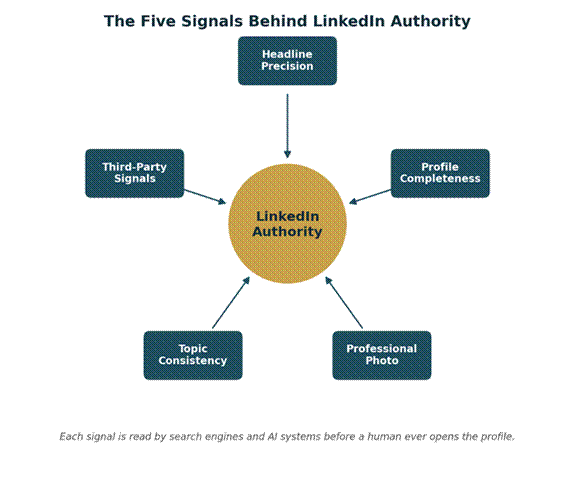
Figure 1 — The five signals search engines and AI read before a human does
Signal One — Headline Precision and LinkedIn Authority
Your headline is indexed more heavily than almost any other field on your profile, because it is the first thing both search algorithms and human readers use to decide what you’re an authority on. A generic title costs you authority immediately, before a reader even opens your profile.
Signal Two — Profile Completeness and LinkedIn Authority
Profile completeness functions as a gate, not a bonus. Profiles that reach full, “All-Star” completeness appear dramatically more often in search than incomplete ones, because incomplete profiles are deprioritised by the ranking system regardless of how strong the underlying keywords are. This is one of the fastest, lowest-effort ways to recover lost ground.
Signal Three — A Professional Photo and LinkedIn Authority
It sounds almost too simple to matter, but a professional photo remains one of the single highest-leverage changes available: profiles with a photo receive many times more views, and considerably more messages, than profiles without one. No other single edit moves the needle as quickly.
Signal Four — Topic Consistency and LinkedIn Authority
It now depends heavily on whether your posting history stays consistent with what your profile claims. A profile that says “brand strategist” but posts inconsistently across unrelated topics sends a confusing signal to a system built to reward specificity. Consistency, not volume, is what compounds — and what the ranking model is actually built to reward.
Signal Five — External and Third-Party Signals of LinkedIn Authority
The final signal sits partly outside your control: how others engage with your content, and whether independent sources — press mentions, client results, featured media — back up what your profile claims. This one is the hardest to build and the one most leaders neglect entirely, which makes it the one most worth deliberate attention. It is also the signal least within any single leader’s direct control, which is exactly why it tends to separate profiles that merely look complete from profiles that genuinely hold weight.
How Search Engines Read LinkedIn Authority
Outside LinkedIn itself, general search engines index public LinkedIn profiles much like any other web page — reading headline text, About copy, and keyword placement to decide what a name should rank for. A profile with vague, generic language gives a search engine almost nothing to work with, so even a strong career can produce a thin, unhelpful search result. This is where a leader’s on-platform standing and their wider machine footprint start to overlap directly.
How AI Assistants Read LinkedIn Authority
Increasingly, the first “reader” of a profile isn’t a person or a search engine at all — it’s an AI assistant asked to summarise someone’s background before a conversation happens. These systems draw heavily on the same signals: headline specificity, About-section clarity, and consistency between what a profile claims and what shows up elsewhere. A profile that reads clearly to a person but vaguely to a language model quietly loses ground in exactly the moments that now matter most — the five seconds before a first meeting.
Three Signs You Have a LinkedIn Authority Gap
Across all five signals, a shortfall here tends to show up the same three ways.
- Your headline still reads like a job title from three roles ago, not what you actually do now — an immediate loss at the single most heavily weighted field on the page.
- Your posting history, if someone scrolled through it, would not clearly support the expertise your headline claims.
- A search of your name turns up little beyond your profile itself — no independent proof that reinforces what the profile is trying to establish.
None of these signs reflect a lack of real expertise. Each one reflects a profile that was set up once and never revisited as the systems reading it changed underneath it.
An Illustrative Example: Rebuilding LinkedIn Authority From Scratch
Consider a hypothetical finance director whose profile hadn’t changed since a promotion two roles ago. Her headline still named her previous title, her About section was three lines of generic language, and her last post was over a year old. Colleagues who knew her work never doubted her ability. But her standing with the platform’s own systems — what actually decided whether she surfaced in search — was close to zero.
Rebuilding it took a rewritten headline naming her actual current scope, a rewritten About section citing two specific outcomes she owned, and a decision to post something genuinely useful roughly once a week. Within a few months, recruiters who had never found her profile in search began to. This example is illustrative, not a documented case study, offered to make the argument concrete rather than to promise an identical result for every reader. What made the difference wasn’t a dramatic overhaul or a paid campaign — it was roughly two hours of deliberate editing, followed by a modest, sustainable posting habit she was able to keep up on her own.
What Building LinkedIn Authority Means in Practice
For a leader auditing their own profile, four questions are worth answering honestly:
- Does my headline describe what I actually do today, in language a stranger or a search engine would recognise?
- Would someone scrolling my last ten posts understand what I’m an authority on?
- Is my profile at full completeness, or are entire sections still blank?
- Is there anything outside my own profile — press, results, features — backing up what I claim on it?
Want a second opinion instead of guessing? Take the free Three-Validation Self-Check below — a short, specific breakdown of where your profile is losing authority with the systems now reading it.
Get a Free LinkedIn Authority Audit
Start with the Three-Validation Self-Check — it covers your machine-layer signals, including LinkedIn, and shows exactly what’s quietly costing you authority.
What This LinkedIn Authority Argument Is Not
This argument is not a case for chasing vanity metrics, posting for the sake of posting, or treating any of this as a substitute for real expertise. A rebuilt profile cannot manufacture capability that isn’t there. What it can do is stop capability that already exists from being invisible to the systems that increasingly decide who gets found first. This article connects to the broader Executive Reputation Systems™ (ERS™) framework, which remains in active development and field-testing, and the guidance here is offered as a working, evidence-informed perspective rather than a guaranteed formula.
Where LinkedIn Authority Work Goes Next
LinkedIn Authority isn’t a one-time fix. As the platform’s ranking systems keep evolving, a profile built for 2023’s rules will keep quietly losing ground even if nothing about the underlying career changes. The leaders who stay visible are the ones who treat their profile the way they’d treat any other asset that compounds — revisited, updated, and kept honest about what it’s actually claiming. A profile audited once a quarter, in under an hour, tends to outperform one that was built carefully once and never touched again.
References & Further Reading
Related Reading
Before exploring the practical application, you may also find these related articles useful:
• The Strategic Reputation Gap Leadership Teams Rarely Measure
• 7 Powerful Reasons Corporate Films Fail to Build Trust
• Build Trust: 3 Proven Reasons Capability Alone Fails
• Executive Branding: 5 Bold Ways AI Visuals Change It
• Executive Influence: What Twenty-Five Years of Being Underestimated Taught Me About Leadership
• Executive Credibility: 5 Costly LinkedIn Mistakes
• Human Validation: 4 Powerful Signals People Need First
• Leadership Capability: 3 Honest Reasons It Goes Unseen
• Machine Validation: 4 Proven AI Footprint Signals
• Leadership Story: 4 Proven Reasons It Sticks
• Executive Influence: 1 Costly Lesson I Nearly Missed
• Market Validation: 4 Proven Signals of Real Recognition
• Visual Identity: 4 Proven Ways AI Builds Consistency
• Validation Gap: 3 Hidden Signs You’re Overlooked
About the Author
Narendra Kumar Chaurasia is the creator of Executive Reputation Systems™ (ERS™), a framework examining how executives and founders build trust and close the Validation Gap across human, digital, and market environments. He has spent 25+ years in sales, marketing, and business growth, and is Co-Founder of CreatorBazaar AI Films.
Connect with the Author
CreatorBazaar AI Films – Official Website
Narendra Kumar Chaurasia – LinkedIn
https://www.linkedin.com/in/narendra-kumar-chaurasia-768209233
CreatorBazaar AI Films – LinkedIn Company Page
https://www.linkedin.com/company/cinemotion-ai-studio
Comments
One of the most important takeaways is topic consistency. When your profile says one thing but your content talks about completely different subjects, your professional positioning becomes unclear.
A strong LinkedIn profile should clearly communicate who you are, what you do and what you are known for. This is where LinkedIn Authority becomes a real strategic advantage.