Brand Strategy Series
By Narendra Kumar Chaurasia
Creator, Executive Reputation Systems™ (ERS™) | Co-Founder, CreatorBazaar AI Films
| In this article: Every leadership team has a Validation Gap running quietly underneath it — the distance between how capable a leader actually is and how capable the market, the machine, and the room believe them to be. This article names the Validation Gap, maps where it hides across three validation systems, and gives leaders a way to spot it in their own career before it costs them a role. |
Table of Contents
1. Executive Summary: The Validation Gap in Brief
2. Why the Validation Gap Forms Even When Capability Is Real
3. The Validation Gap Inside Human Validation
4. The Validation Gap Inside Machine Validation
5. The Validation Gap Inside Market Validation
6. Three Signs You Are Living Inside the Validation Gap
7. An Illustrative Example: From Validation Gap to Validated Leader
8. What Closing the Validation Gap Means in Practice
9. What This Validation Gap Argument Is Not
10. Where the Validation Gap Work Goes Next
11. References & Further Reading
12. Related Reading
13. About the Author
Executive Summary: The Validation Gap in Brief
The Validation Gap is the quiet distance between real capability and recognised capability. Most leaders never name it, yet it quietly decides who gets the next mandate, the next board seat, the next outside opportunity. This article maps the gap across three validation systems — human, machine, and market — connecting to the Human, Machine, and Market Validation layers of Executive Reputation Systems™ (ERS™), a framework currently in active development and field-testing with executives and founders.
By the end, a leader should be able to name exactly where their own gap sits, and which system to build out first. The goal is not more effort inside the job already being done well. The goal is deliberate, visible proof of what that work has actually produced. Across a growing body of workplace research, the pattern is consistent: capable people are routinely passed over not because their work is weak, but because it was never made legible to the people deciding who moves next. Naming the gap is the first step toward changing that outcome for good.
Why the Validation Gap Forms Even When Capability Is Real
Capability and recognition are meant to move together. In practice, they rarely do, and that divergence is where the gap opens. A leader can be promoted internally on trust, quietly closing any internal shortfall, yet remain invisible externally because no outside signal confirms what the internal team already knows. Recognition, unlike competence, is not self-explaining. It has to be built, documented, and reinforced across three separate audiences, and most careers only ever address one of them. That narrow focus is exactly how a Validation Gap forms in the first place, often without anyone inside the organization noticing.
How the Validation Gap Builds Inside a Single Organization
Inside one organization, the gap can stay hidden for years. A leader delivers, a manager notices, a small circle trusts the work, and that trust quietly substitutes for any wider proof. The problem only becomes visible the moment that leader needs to be evaluated by people who were never in the room — a board considering an outside candidate, a search committee working from a shortlist, a market forming a first impression from a five-second scan of a LinkedIn profile. By then, the Validation Gap has usually been building for years, unnoticed precisely because everything inside the organization still worked exactly as intended.
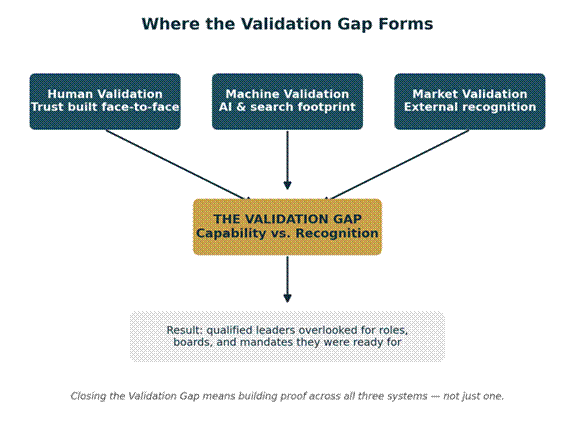
Figure 1 — Where the Validation Gap forms: three validation systems, one blind spot
The Validation Gap Inside Human Validation
Human validation is the layer most leaders already understand, even without a formal name for it. It is built face-to-face — in meetings, in delivery, in the small trust decisions colleagues make every week about whether to back a leader’s judgment on something that matters. Most executives are strong here, because it is the one system a career naturally builds without any deliberate strategy behind it at all.
Why Human Validation Alone Cannot Close the Validation Gap
The trouble is that this layer alone cannot close a wider gap, because it does not travel. The trust a leader earns inside one room stays inside that room. A colleague who has watched someone operate for a decade cannot transfer that conviction to a stranger evaluating a shortlist six months from now. This is precisely where the divide starts to widen for otherwise strong performers: human trust is real, but it is local, and a career eventually needs recognition that carries further than the room it was built in.
The Validation Gap Inside Machine Validation
The second place the gap hides is machine validation — the digital footprint search engines and AI systems now use to assess a leader before any human conversation happens. A growing share of evaluation starts here: a name gets searched, an AI assistant gets asked to summarise someone’s background, well before a shortlist is even discussed out loud. If that search returns little reflecting a leader’s actual scope of work, the divide widens automatically, regardless of how strong the underlying capability genuinely is.
A Quick Validation Gap Check for the Machine Layer
A fast way to test this layer: search your own name, then ask honestly what a stranger — or an AI system summarising your background — would conclude about your actual scope of responsibility. If the answer is “not much,” this part of the gap is already open, quietly, whether or not anyone inside the organization has noticed it yet.
The Validation Gap Inside Market Validation
The third layer is market validation — the external proof that a leader is known for the right thing, by people well outside their own organization. This layer decides whether someone lands on a shortlist before that shortlist is even written down, and it is the one most consistently left to chance. Strong internal performance and a healthy digital footprint still don’t guarantee the market has formed an accurate, specific picture of what a leader is genuinely good at — and that missing picture is where the Validation Gap does its most expensive, least visible damage.
Three Signs You Are Living Inside the Validation Gap
Across all three layers, the gap tends to leave the same three fingerprints on a career, and each one is worth checking honestly.
- A search of your name returns little that reflects your actual scope of responsibility, so anyone evaluating you from outside the room starts from a blank page — a machine-layer version of the Validation Gap.
- Your reputation depends entirely on people who already know you, with no independent, external proof a stranger could verify in under a minute — a human-layer gap with nowhere left to travel.
- You have been passed over for a mandate you were genuinely qualified for, by someone whose visible footprint was simply larger than yours — the market-layer gap showing up as a real, costly loss.
None of these signs point to a skills deficit. Each one points to a validation system that was never deliberately built — which is the actual definition of a gap, rather than a competence problem in disguise.
An Illustrative Example: From Validation Gap to Validated Leader
Consider a hypothetical regional operations leader with a strong internal track record: reliable delivery, trusted by leadership, well regarded by peers. When a group-level role opened up, the shortlist was built by people two levels removed from her daily work. Her name never surfaced — not because her results were weaker than the candidates who made the list, but because her gap was wider. She had little independent search presence, no external recognition beyond her own function, and a reputation that lived entirely inside conversations other people weren’t part of.
Closing that particular gap did not require new skills. It required making capability that already existed visible across the two systems she had left untouched for years. This example is illustrative, not a documented case study — offered to make the argument concrete, not to promise a guaranteed outcome for every reader. What changed for her afterward wasn’t a new job title or a louder voice in meetings. It was a deliberate decision to spend a fraction of the time she already invested in delivery on making that delivery visible beyond the people who watched it happen firsthand.
What Closing the Validation Gap Means in Practice
For a leader assessing their own position, four honest questions are worth sitting with:
- If a stranger searched my name today, would what they find match my actual scope and impact?
- Does my reputation depend entirely on people who already know me, or does some of it travel on its own, without me in the room?
- Have I ever lost a mandate to someone whose visible footprint was larger than their actual track record?
- Which of the three systems — human, machine, market — have I never deliberately built out?
Want to see exactly where your own gap sits right now? Take the Three-Validation self-check linked below, or ask for a free mini self-assessment of your current footprint across all three layers.
Take the Three-Validation Self-Check
See exactly where your own Validation Gap sits across human, machine, and market recognition — and which one to fix first.
What This Validation Gap Argument Is Not
It’s worth being precise about what this argument does not claim. It is not a case for prioritising visibility over genuine capability, or for assuming that closing the gap substitutes for underlying work that has to be real first. Validation supports capability; it never replaces it. This article, and the broader Executive Reputation Systems™ (ERS™) framework it connects to, remains in active development and field-testing. The model described here is offered as a working, evidence-informed perspective, not a finished, independently validated instrument, and readers should treat it accordingly.
Where the Validation Gap Work Goes Next
Most leaders don’t need to reinvent how they work, and they rarely need a louder personal brand either. They need an honest look at where their own gap sits across human, machine, and market recognition — and a realistic, sequenced way to close whichever layer has been left to chance the longest. That honest look is usually the harder step. Building the proof, once the gap is named, tends to move faster than most leaders expect — often a matter of weeks of deliberate attention rather than years of quiet hoping that the work will eventually speak for itself. It rarely does, on its own, no matter how good the work actually is.
References & Further Reading
Related Reading
Before exploring the practical application, you may also find these related articles useful:
• The Strategic Reputation Gap Leadership Teams Rarely Measure
• 7 Powerful Reasons Corporate Films Fail to Build Trust
• Build Trust: 3 Proven Reasons Capability Alone Fails
• Executive Branding: 5 Bold Ways AI Visuals Change It
• Executive Influence: What Twenty-Five Years of Being Underestimated Taught Me About Leadership
• Executive Credibility: 5 Costly LinkedIn Mistakes
• Human Validation: 4 Powerful Signals People Need First
• Leadership Capability: 3 Honest Reasons It Goes Unseen
• Machine Validation: 4 Proven AI Footprint Signals
• Leadership Story: 4 Proven Reasons It Sticks
• Executive Influence: 1 Costly Lesson I Nearly Missed
• Market Validation: 4 Proven Signals of Real Recognition
• Visual Identity: 4 Proven Ways AI Builds Consistency
About the Author
Narendra Kumar Chaurasia is the creator of Executive Reputation Systems™ (ERS™), a framework examining how executives and founders build trust and close the Validation Gap across human, digital, and market environments. He has spent 25+ years in sales, marketing, and business growth, and is Co-Founder of CreatorBazaar AI Films.
Connect with the Author
CreatorBazaar AI Films – Official Website
Narendra Kumar Chaurasia – LinkedIn
https://www.linkedin.com/in/narendra-kumar-chaurasia-768209233
CreatorBazaar AI Films – LinkedIn Company Page
https://www.linkedin.com/company/cinemotion-ai-studio
Comments