Board Readiness Series
By Narendra Kumar Chaurasia
Creator, Executive Reputation Systems™ (ERS™) |CreatorBazaar AI Films
In this article: Independent Director selection is a quiet process that starts long before any interview. Boards check your Google results, your LinkedIn profile and your public proof of thinking first. Most aspirants have not caught up to that reality, and it shows in five costly, specific ways.
Table of Contents: Independent Director Guide
- Why Every Independent Director Aspirant Hits the Same Wall
- Reason 1: An Independent Director Candidate Gets Googled First
- Reason 2: No Proof of Independent Director Thinking
- Reason 3: An Independent Director Profile That Reads Like a Resume
- Reason 4: Mixed Search Results Hurt an Independent Director Bid
- Reason 5: The Invisible Independent Director Candidate
- Independent Director Story: Two Candidates, Two Outcomes
- The Independent Director Fix List
- Independent Director Self-Check: 5 Quick Questions
- Conclusion: Your Independent Director Journey Starts Early
- References & Further Reading for Independent Director Aspirants
- About the Author
- Related Reading Beyond the Independent Director Topic
Across India, thousands of experienced professionals now want to become an independent director. Middle managers, senior leaders, CFOs and CEOs all see the same opportunity: a respected board seat, a second career, and a voice in how companies are governed.
But here is the truth most people do not hear. Wanting a board seat is easy. Being chosen is hard. Most people with strong careers are still rejected, and often they never learn why.
This article explains five simple, costly reasons. None of them is about your experience. All of them are about how you are seen.
Why Every Independent Director Aspirant Hits the Same Wall
An independent director is not hired for doing the work. They are chosen for judgment, independence and trust. A board needs to feel safe before it invites someone in.
That feeling of safety is built long before any interview. It comes from what the board, the promoters and the search committee already know about you. In most cases, they know it from three places: a quick Google search, your LinkedIn profile, and what trusted people say about you.
Think of it like a first meeting at a business dinner. People form an opinion in the first few minutes, and they rarely change it later. In the same way, a search committee forms a view of you from what is easy to find. If that view is thin or unclear, even a long and impressive career cannot rescue it, because nobody has the time to dig deeper.
So the wall is this: you may be fully qualified, but if your visible reputation does not match your real experience, the decision is made quietly, without you in the room.
Reason 1: An Independent Director Candidate Gets Googled First
Before a call, before a meeting, before a coffee, someone types your name into Google. This is normal, and it takes less than a minute.
For an independent director role, the stakes are higher. Boards carry legal and reputational risk. A wrong appointment can hurt the company, so they check carefully.
What do they find when they search for you? If the answer is “very little,” that is a problem. If the answer is “an old news item, a wrong profile, or someone with the same name,” that is a bigger problem. A strong candidate controls this first impression instead of leaving it to chance.
Simple action: Search your own name today in a private window. Write down the first ten results. That list is your first interview.
Reason 2: No Proof of Independent Director Thinking
Boards do not want people who only say, “I have 25 years of experience.” They want proof that you think independently, ask good questions and hold your ground politely.
Many candidates have this ability but have never shown it in public. They have not written about governance. They have not shared a view on risk, ethics or strategy. So the board has nothing to read, nothing to quote, and nothing to trust.
A candidate earns the seat by showing a pattern of clear thinking over time. A few thoughtful posts, a short article, or a talk at an industry event can serve as that proof.
Simple action: Write one short post every two weeks on a business or governance issue you understand well. Keep it simple and honest.
Reason 3: An Independent Director Profile That Reads Like a Resume
Most LinkedIn profiles look the same. Job titles, dates and a list of duties. This works for hiring managers. It does not work for a board.
A board reads your profile to answer a different question: “Can this person sit with us, challenge us and protect our shareholders?” A list of past jobs does not answer that.
A strong board-ready profile has a clear headline, a short summary about your judgment and values, and a few examples of tough decisions you handled. It speaks about outcomes and character, not only about titles.
Simple action: Rewrite your LinkedIn headline so that it says what kind of board value you bring, not only your current designation.
Reason 4: Mixed Search Results Hurt an Independent Director Bid
Sometimes the problem is not too little information. It is the wrong information.
Old company disputes, a name clash with another person, outdated press notes, or a half-finished profile on some random website can create doubt. A board does not have time to investigate. When in doubt, they simply move to the next name.
For a board candidate, doubt is expensive because trust is the whole product. You do not need a perfect search page. You need a clear, consistent and recent one, where the best results are the ones you control or approve.
Simple action: Make sure your name, photo, bio and designation are the same across LinkedIn, your company page and any speaker or media profile.
Reason 5: The Invisible Independent Director Candidate
This is the most common reason of all. Many strong professionals believe, “My work will speak for itself.” In boardrooms, it rarely does.
Board nominations usually run on networks, recommendations and visible credibility. If nobody outside your company knows what you stand for, nobody will think of you when a seat opens. Good people lose these seats every year only because they were never seen.
Being visible does not mean being loud. It means being easy to find, easy to understand and easy to recommend. A calm, steady presence beats a sudden burst of attention.
Simple action: Pick two places, such as LinkedIn and one industry forum, and show up there regularly for 90 days.
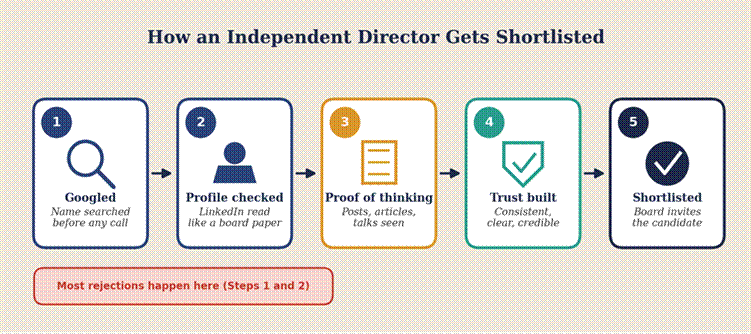
Alt text: Flowchart showing how an independent director candidate moves from being searched on Google to being shortlisted.
Caption: Every independent director shortlist follows this quiet path, and most rejections happen in the first two steps.
Independent Director Story: Two Candidates, Two Outcomes
Imagine two senior finance leaders, both with 25 years of experience. Both want to become an independent director. Call them Candidate A and Candidate B. This is an illustrative example, not a real case.
Candidate A has a strong career but almost no public presence. A search shows one old company page and a blurry photo. The LinkedIn headline says only “Vice President, Finance.” There are no articles, no views shared, and no recommendations from outside the company.
Candidate B has the same career. But the search shows a clear LinkedIn profile, two short articles on financial controls, a speaker note from an industry event, and recommendations from respected peers. The headline says “Finance leader | Audit and risk oversight | Aspiring independent director.”
When a search committee needs a name, who gets the call? Almost always Candidate B. Nothing about the experience is different. Only the visible proof is different. This is why the independent director race is often won before it begins.
The Independent Director Fix List
If you want a board seat, work on these five areas in order:
- Google presence: Know what appears when your name is searched, and fix gaps.
- Profile clarity: Present judgment, values and outcomes, not only job titles.
- Proof of thinking: Share your views on governance, risk and leadership.
- Consistency: Keep name, photo and bio the same everywhere.
- Visibility: Show up steadily for the right audience.
None of these needs a big budget. All of them need patience and a plan. The earlier you start, the stronger your case when a board seat opens.
Independent Director Self-Check: 5 Quick Questions
Answer yes or no to each question below.
- Do my top Google results show the right name, photo and designation?
- Does my LinkedIn headline explain the board value I bring?
- Have I shared my views on governance or risk in the last 90 days?
- Are my details the same on every platform?
- Can three trusted people recommend me as an independent director today?
If you answered no to two or more, your board journey needs a visibility plan before your next application.
Conclusion: Your Independent Director Journey Starts Early
An independent director is chosen for trust, and trust is built in public long before the formal process begins. If you are qualified but still being rejected, the problem is probably not your experience. It is your visible reputation.
Remember that reputation is not built in a week. Small, steady actions repeated for three to six months create a very different picture. Begin today, because the best time to be seen is before you need to be chosen.
Start with what Google shows about you. Fix your profile. Share your thinking. In a few months, your name will look very different to the people who matter.
Want a clear view of where you stand? Book a 30-minute call for LinkedIn Optimization, Personal Branding, Executive Reputation & Google Footprint: https://cal.com/narendra-kumar-chaurasia-lucknow-45hytf/30min
References & Further Reading for Independent Director Aspirants
- Ministry of Corporate Affairs, Companies Act 2013 and independent director rules: https://www.mca.gov.in/
- SEBI, Listing Obligations and Disclosure Requirements for boards: https://www.sebi.gov.in/
- Indian Institute of Corporate Affairs, independent director databank and learning: https://www.iica.nic.in/
About the Author
Narendra Kumar Chaurasia — Creator, Executive Reputation Systems™ (ERS™) | CreatorBazaar AI Films
Website: https://creatorbazaarglobal.com/
Personal LinkedIn: https://www.linkedin.com/in/narendra-kumar-chaurasia-768209233
Company LinkedIn: https://www.linkedin.com/company/cinemotion-ai-studio/?viewAsMember=true
Related Reading Beyond the Independent Director Topic
- The Strategic Reputation Gap Leadership Teams Rarely Measure
- 7 Powerful Reasons Corporate Films Fail to Build Trust
- Build Trust: 3 Proven Reasons Capability Alone Fails
- Executive Branding: 5 Bold Ways AI Visuals Change It
- Executive Influence: What Twenty-Five Years of Being Underestimated Taught Me About Leadership
- Executive Credibility: 5 Costly LinkedIn Mistakes
- Human Validation: 4 Powerful Signals People Need First
- Leadership Capability: 3 Honest Reasons It Goes Unseen
- Machine Validation: 4 Proven AI Footprint Signals
- Leadership Story: 4 Proven Reasons It Sticks
- Executive Influence: 1 Costly Lesson I Nearly Missed
- Market Validation: 4 Proven Signals of Real Recognition
- Visual Identity: 4 Proven Ways AI Builds Consistency
- Validation Gap: 3 Hidden Signs You’re Overlooked
- LinkedIn Authority: 5 Signals AI Actually Reads
- Leadership Thinking: 3 Costly Signs You’re Just Busy
- Founder Blind Spot: 3 Costly Signs You’re Known Wrong
- LinkedIn Search Signal: 5 Hidden Ways AI Reads You
Comments