LinkedIn Search Signal Series
By Narendra Kumar Chaurasia
Creator, Executive Reputation Systems™ (ERS™) | Co-Founder, CreatorBazaar AI Films
| In this article: Your LinkedIn Search Signal is the combination of ranking factors that decides whether your profile actually surfaces when someone searches, or whether an AI assistant can summarise your work accurately at all. This article breaks down the five hidden factors behind it, how search engines and AI systems actually read it, and how to tell whether yours is currently working for you or against you. |
Table of Contents
1. Executive Summary: LinkedIn Search Signal in Brief
2. Why LinkedIn Search Signal Matters More Than a Polished Profile
3. The Five Signals Behind a Strong LinkedIn Search Signal
4. How Search Engines Read Your LinkedIn Search Signal
5. How AI Assistants Read Your LinkedIn Search Signal
6. Three Signs Your LinkedIn Search Signal Is Weak
7. An Illustrative Example: Strengthening a LinkedIn Search Signal
8. What Improving Your LinkedIn Search Signal Means in Practice
9. What This LinkedIn Search Signal Argument Is Not
10. Where LinkedIn Search Signal Work Goes Next
11. References & Further Reading
12. Related Reading
13. About the Author
Executive Summary: LinkedIn Search Signal in Brief
A LinkedIn Search Signal is not the same thing as a polished profile. It’s the specific set of ranking factors — headline text, completeness, activity, consistency, outside corroboration — that LinkedIn’s own search, general search engines, and increasingly AI assistants all read before a human ever does. A senior manager can have an excellent, well-written profile and still carry a weak version of it, because the two are evaluated on almost entirely different criteria. Complete profiles receive roughly thirty times more weekly views than incomplete ones, and LinkedIn’s newest ranking systems now weigh semantic consistency as heavily as keyword matching. Most professionals have never checked which of the two their own profile is actually optimised for. A decade ago, a strong network and a well-written summary were usually enough to look credible at a glance. That shortcut has largely stopped working, because the systems doing the evaluating have gotten considerably better at telling the difference between a profile that reads well and one that actually holds up under a structured check.
Why LinkedIn Search Signal Matters More Than a Polished Profile
A profile can be well-written and still be functionally invisible. Good writing is judged by a human reader; this signal is judged by a ranking system that doesn’t read for tone or polish, it reads for specific, structured evidence. A senior manager might spend an afternoon perfecting the prose in their About section while leaving the one field the ranking system actually weights most heavily — the headline — untouched since a promotion two roles ago.
How LinkedIn Search Signal Changed With AI Search
The shift accelerated once LinkedIn began routing profile evaluation through a large AI model as part of its feed and search ranking, built specifically to read context across a profile rather than just count keywords. That model treats the signal as a coherence check: does the headline match the About section, does the About section match the experience history, does the experience history match what’s actually been posted recently. A profile that scores well on any one of those in isolation but fails the coherence check across all of them produces a noticeably weaker signal than the sum of its parts would suggest.
The Five Signals Behind a Strong LinkedIn Search Signal
Research on how LinkedIn’s ranking systems actually evaluate a profile points to five factors that consistently drive a strong LinkedIn Search Signal above all others.
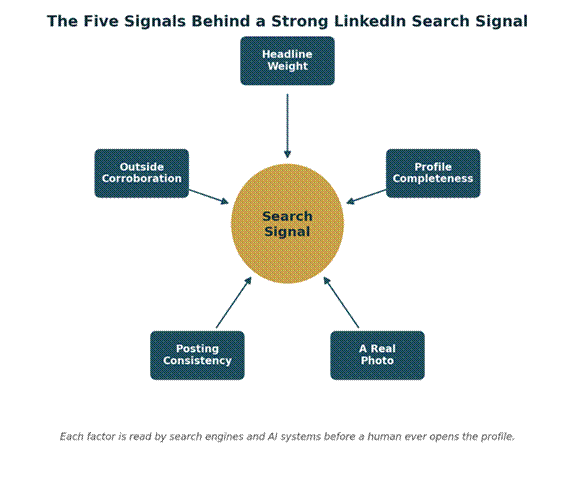
Figure 1 — The five factors search engines and AI read before a human does
Factor One — Headline Weight in Your LinkedIn Search Signal
The headline carries more ranking weight than almost any other field, because it’s the first thing both the algorithm and a human scanning search results use to decide relevance. A headline that still describes a role from several positions ago actively drags the whole thing down, regardless of how well the rest of the profile reads.
Factor Two — Completeness and Your LinkedIn Search Signal
An incomplete profile is deprioritised outright, not just penalised slightly. Reaching full profile completeness is one of the highest-leverage, lowest-effort changes available here, because incomplete sections function as a gate the ranking system won’t let a profile past, no matter how strong the filled-in sections are.
Factor Three — A Real Photo in Your LinkedIn Search Signal
It’s a small detail with an outsized effect: profiles with a professional photo receive dramatically more views and messages than profiles without one. Almost nothing else moves it this quickly for this little effort.
Factor Four — Posting Consistency and Your LinkedIn Search Signal
A ranking system built to reward specificity reads inconsistent posting as a weak signal, even when the individual posts are good. A senior manager whose headline claims one specialty but whose last ten posts cover five unrelated topics sends a confusing signal that actively works against them.
Factor Five — Outside Corroboration in Your LinkedIn Search Signal
The final and hardest factor to control: whether anything outside the platform — press, client results, third-party mentions — backs up what the profile claims. This is the piece most senior managers never think to build deliberately, which makes it the one most worth starting on early. It’s also the one factor a founder or manager can’t simply write their way into — it has to be earned through actual visible work, which is exactly why it carries so much weight once it exists.
How Search Engines Read Your LinkedIn Search Signal
Outside LinkedIn entirely, general search engines index public profiles the same way they’d index any other web page, using headline text and structured data to decide what a name should rank for. A vague or outdated headline gives a search engine almost nothing usable, which means a strong career can still produce a thin, unhelpful search presence.
How AI Assistants Read Your LinkedIn Search Signal
Increasingly, the first “reader” of a profile is an AI assistant asked to summarise someone’s background before a meeting or introduction happens. These tools draw on the same underlying factors as the ranking systems themselves — headline specificity, consistency, corroboration — meaning weakness here now costs a senior manager credibility in exactly the moments that matter most: the few seconds before someone forms a first impression.
Three Signs Your LinkedIn Search Signal Is Weak
Across senior managers and LinkedIn users in very different fields, this weakness tends to show up the same three ways.
- Your own name search turns up a profile that doesn’t reflect your actual current scope, so an AI summary or a recruiter’s first search starts from an inaccurate baseline.
- Your last ten posts, read together, wouldn’t tell a stranger what you’re actually known for.
- Nothing outside your own profile — press, results, third-party mentions — currently backs up what your profile claims about you.
None of these signs reflect a lack of real seniority or expertise. They reflect a profile that hasn’t been revisited since the ranking systems reading it changed underneath it.
An Illustrative Example: Strengthening a LinkedIn Search Signal
Consider a hypothetical senior finance manager whose profile hadn’t meaningfully changed in two years. Her headline still named a previous title, her About section was generic, and her last post predated her current role entirely. Colleagues never doubted her capability. Measured purely by what the ranking systems could actually read, hers told a very different story.
Rebuilding it took a rewritten headline naming her current scope precisely, an About section citing two specific outcomes she owned, and a modest, sustainable habit of posting something genuinely useful roughly every ten days. Within a few months, her profile began surfacing in searches it had never appeared in before. This example is illustrative, not a documented case study, offered to make the argument concrete rather than to promise an identical result for every reader. What changed wasn’t a new skill or a different job. It was roughly two hours of deliberate editing, followed by a sustainable habit she was able to keep up without it ever feeling like a second job.
What Improving Your LinkedIn Search Signal Means in Practice
For a senior manager auditing their own profile, four questions are worth answering honestly:
- Does my headline describe what I do today, in language a search engine or AI assistant would actually recognise?
- Would someone reading my last ten posts understand what I’m known for?
- Is my profile at full completeness, or are entire sections still sitting blank?
- Is there anything outside my own profile currently backing up what I claim on it?
Want a specific, personalised read on where your own LinkedIn Search Signal currently stands? A free audit is available below — a short, honest breakdown of what’s working and what’s quietly costing you visibility.
Get a Free LinkedIn Search Signal Audit
Start with the Three-Validation Self-Check — it covers your machine-layer signals, including LinkedIn, and shows exactly what’s quietly costing you visibility.
What This LinkedIn Search Signal Argument Is Not
This isn’t a case for gaming an algorithm, posting for the sake of posting, or treating ranking factors as a substitute for real expertise. A rewritten profile can’t manufacture seniority that isn’t there. What strengthening a LinkedIn Search Signal can do is stop real expertise from being invisible to the systems that increasingly decide who gets found, searched, and summarised first.
Where LinkedIn Search Signal Work Goes Next
None of this is something to fix once and forget. As ranking systems keep evolving, a profile optimised for last year’s rules will keep quietly losing ground even if nothing about the underlying career changes. Senior managers who stay visible tend to be the ones who treat their profile the way they’d treat any other asset worth maintaining — revisited on a regular cadence, and kept honest about what it’s actually claiming. A quarterly check, done in under an hour, tends to outperform a profile that was carefully built once, years ago, and never opened again since.
References & Further Reading
Related Reading
Before exploring the practical application, you may also find these related articles useful:
• The Strategic Reputation Gap Leadership Teams Rarely Measure
• 7 Powerful Reasons Corporate Films Fail to Build Trust
• Build Trust: 3 Proven Reasons Capability Alone Fails
• Executive Branding: 5 Bold Ways AI Visuals Change It
• Executive Influence: What Twenty-Five Years of Being Underestimated Taught Me About Leadership
• Executive Credibility: 5 Costly LinkedIn Mistakes
• Human Validation: 4 Powerful Signals People Need First
• Leadership Capability: 3 Honest Reasons It Goes Unseen
• Machine Validation: 4 Proven AI Footprint Signals
• Leadership Story: 4 Proven Reasons It Sticks
• Executive Influence: 1 Costly Lesson I Nearly Missed
• Market Validation: 4 Proven Signals of Real Recognition
• Visual Identity: 4 Proven Ways AI Builds Consistency
• Validation Gap: 3 Hidden Signs You’re Overlooked
• LinkedIn Authority: 5 Signals AI Actually Reads
• Leadership Thinking: 3 Costly Signs You’re Just Busy
• Founder Blind Spot: 3 Costly Signs You’re Known Wrong
About the Author
Narendra Kumar Chaurasia is the creator of Executive Reputation Systems™ (ERS™), a framework examining how executives and founders build trust and close the Validation Gap across human, digital, and market environments. He has spent 25+ years in sales, marketing, and business growth, and is Co-Founder of CreatorBazaar AI Films.
Connect with the Author
CreatorBazaar AI Films – Official Website
Narendra Kumar Chaurasia – LinkedIn
https://www.linkedin.com/in/narendra-kumar-chaurasia-768209233
CreatorBazaar AI Films – LinkedIn Company Page
https://www.linkedin.com/company/cinemotion-ai-studio
Comments