Founder Brand Strategy Series
By Narendra Kumar Chaurasia
Creator, Executive Reputation Systems™ (ERS™) | Co-Founder, CreatorBazaar AI Films
Table of Contents
1. Executive Summary: Founder Brand Strategy in Brief
2. Why Founder Brand Strategy Often Gets the “Known For” Part Wrong
3. What a Real Founder Brand Strategy Actually Controls
4. Three Costly Signs Your Founder Brand Strategy Is Gone Wrong
5. An Illustrative Example: Realigning a Founder Brand Strategy
6. What Fixing Founder Brand Strategy Means in Practice
7. What This Founder Brand Strategy Argument Is Not
8. Where Founder Brand Strategy Work Goes Next
9. References & Further Reading
10. Related Reading
11. About the Author
Executive Summary: Founder Brand Strategy in Brief
A Founder Brand Strategy is meant to be the deliberate answer to one question: what do we want to be known for, and how do we make sure the market actually believes it. In practice, most organisations and individual leaders write the answer once, then quietly stop checking whether the market’s actual perception still matches it. Harvard Business School research on brand positioning consistently finds that the gap between a stated position and a market’s actual perception is where value quietly leaks out — not from a bad Founder Brand Strategy on paper, but from one nobody has verified against reality in years. The tools used to study this at scale — perceptual maps, positioning audits, structured customer interviews — all start from the same underlying assumption: what a company or individual believes it represents and what the market has actually absorbed are two separate data points, and only one of them can be checked by simply reading the strategy document again.
Why Founder Brand Strategy Often Gets the “Known For” Part Wrong
A Founder Brand Strategy document usually reads well. It names a differentiator, a target audience, a tone, a promise. What it rarely does is check whether any of that has actually landed with the people it was written for. Writing the document is, by a wide margin, the easy half. Verifying it against an outside perspective — the half most likely to reveal an uncomfortable gap — is the half that gets skipped almost everywhere, not because it’s difficult, but because nobody is specifically responsible for doing it once the launch or the rebrand is behind them. The positioning can be internally coherent and externally invisible at the same time — everyone inside the room agrees on the positioning, while nobody outside the room has ever heard it stated that clearly, let alone repeated it back.
How Founder Brand Strategy Drifts From Intent to Perception
The drift is rarely dramatic. A Founder Brand Strategy gets set once, at a planning offsite or a rebrand, and from that point forward the market’s actual perception is left to accumulate on its own — through whatever content gets published, whatever a founder happens to post, whatever a client happens to repeat to a colleague. None of that is coordinated back to the original document, so perception and intention slowly pull apart, one uncoordinated impression at a time, until the words on paper no longer describe what people actually think.
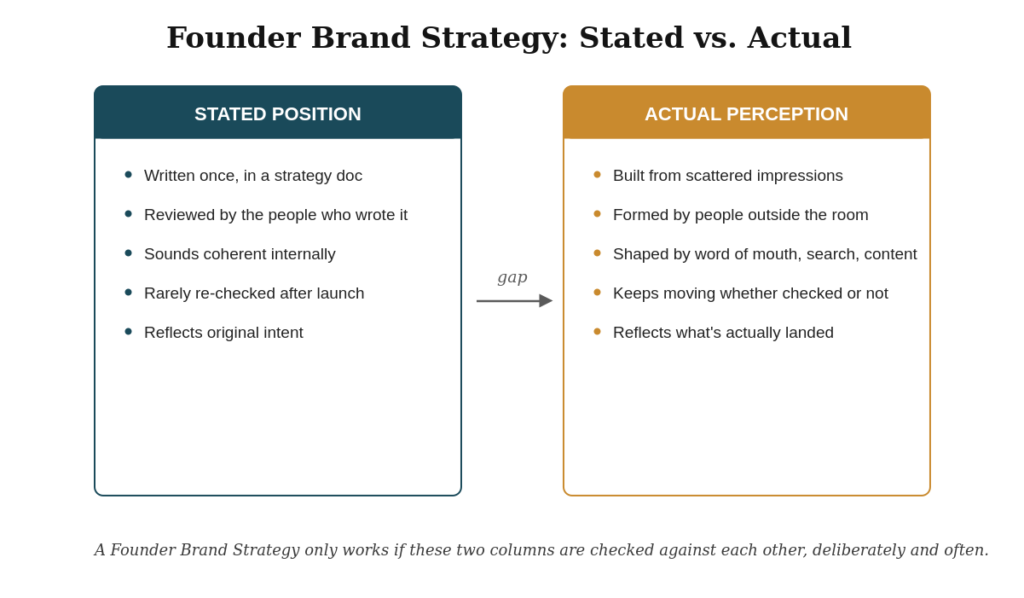
Figure 1 — Where a Founder Brand Strategy’s stated position and actual perception pull apart
What a Real Founder Brand Strategy Actually Controls
It cannot control what people think directly. What it can control is the consistency of the signals a market receives — the same core message, repeated in a recognisable way, across every place a customer or peer might encounter it. Perceptual mapping research from Harvard Business School treats this precisely as a positioning exercise: plotting where a brand actually sits in a customer’s mind against where it was intended to sit, on the attributes that customer actually cares about. The exercise only works, though, if the inputs come from actual customers and prospects rather than from the same internal team that wrote the original positioning — otherwise the map simply reflects the strategy back at itself, confirming what everyone already believed rather than testing it.
Why Founder Brand Strategy Fails Without Outside Verification
This is the part most individuals and smaller companies skip entirely. A positioning document reviewed only by the people who wrote it will always look correct, because everyone reviewing it already believes the intended positioning. The only way to know whether it’s actually landing is to ask people who were never in the room how they’d describe you — and to treat any mismatch as data, not as a communication failure to be argued away. That reframing matters more than it sounds. The instinctive response to hearing your positioning described incorrectly is to explain why the listener got it wrong. The useful response is to treat their answer as accurate evidence of where the gap actually sits, and adjust the strategy toward what’s already landing rather than toward what was originally intended.
Three Costly Signs Your Founder Brand Strategy Is Gone Wrong
Across very different organisations and personal brands, the same three signs tend to show up when this drift has already happened.
- Ask ten people who know your work to describe what you’re known for in one sentence, and you get ten different answers, none matching the language in your own positioning.
- Your content and positioning keep referencing a differentiator competitors have since matched or overtaken, while your own materials haven’t been updated to reflect it.
- New clients or partners routinely have to be corrected on what you actually do, because their first impression came from somewhere your Founder Brand Strategy never actually reached — a search result, a secondhand recommendation, an old piece of content that outranks anything current.
None of these signs mean the underlying capability is weak. They mean the strategy meant to represent that capability has quietly stopped matching what the market has actually absorbed.
An Illustrative Example: Realigning a Founder Brand Strategy
Consider a hypothetical mid-size consultancy whose Founder Brand Strategy, written three years earlier, positioned the firm around a specific analytical methodology. Internally, everyone still described the firm that way. Externally, new clients consistently described them as “the team that fixes messy projects” — a reputation built almost entirely through word of mouth, unrelated to the methodology the strategy document still led with.
Neither position was wrong exactly, but only one of them was the one actually attracting business. Realigning the strategy didn’t mean starting over. It meant updating the stated position to match the perception that had already proven itself in the market, rather than defending a differentiator the market had quietly stopped noticing. This example is illustrative, not a documented case study, offered to make the argument concrete rather than to promise an identical outcome for every reader. The real lesson wasn’t that the original methodology had stopped mattering entirely — it still underpinned the actual work. The lesson was that leading with it in every piece of external communication was quietly working against the reputation that was already doing the heavy lifting of winning new business.
What Fixing Founder Brand Strategy Means in Practice
For anyone auditing their own positioning, four honest questions are worth asking:
- If I asked ten people who know my work to describe it in one sentence, would their answers agree with each other, and with what I’d say myself?
- Is my current positioning still built around a differentiator that’s genuinely still true, or one that made sense several years ago?
- Where does most of my actual reputation come from — my own stated positioning, or word of mouth that grew up around it unmanaged?
- Have I ever deliberately checked outside perception against my strategy, or only refined the strategy document itself?
Want a structured way to check this across more than just your Founder Brand Strategy statement? The Three-Validation Self-Check below covers the same gap across your human, machine, and market signals — including whether your stated position is the one actually reaching people.
Take the Three-Validation Self-Check
See whether your Founder Brand Strategy is the one actually reaching people — across human, machine, and market signals.
What This Founder Brand Strategy Argument Is Not
This isn’t a case for chasing whatever the market happens to think, abandoning a differentiator the moment it feels less fresh, or treating perception as more important than the underlying work. It still has to be built on something real. The argument is narrower: a strategy that was accurate once needs deliberate, periodic verification against actual perception, because perception keeps moving whether or not the strategy document does.
Where Founder Brand Strategy Work Goes Next
None of this requires abandoning what a Founder Brand Strategy got right in the first place. Most leaders don’t need an entirely new one. They need an honest, periodic check on whether the one they already have still matches what the market has actually absorbed — and the discipline to update the strategy rather than the discipline to keep defending it. That check tends to be uncomfortable the first time, because it usually surfaces at least one gap nobody had noticed. It gets noticeably easier with repetition, in the same way any regular audit does — the first one finds the backlog of drift that accumulated while nobody was checking, and every one after that catches a much smaller gap, closer to when it first appeared. It tends to be far less uncomfortable than discovering the same gap from a lost deal, an overlooked shortlist, or a client who describes the work in a way the strategy never anticipated. A brief, honest conversation with people outside the room costs an afternoon. A misaligned reputation, left unchecked for another year, tends to cost considerably more than that.
References & Further Reading
Related Reading
Before exploring the practical application, you may also find these related articles useful:
• The Strategic Reputation Gap Leadership Teams Rarely Measure
• 7 Powerful Reasons Corporate Films Fail to Build Trust
• Build Trust: 3 Proven Reasons Capability Alone Fails
• Executive Branding: 5 Bold Ways AI Visuals Change It
• Executive Influence: What Twenty-Five Years of Being Underestimated Taught Me About Leadership
• Executive Credibility: 5 Costly LinkedIn Mistakes
• Human Validation: 4 Powerful Signals People Need First
• Leadership Capability: 3 Honest Reasons It Goes Unseen
• Machine Validation: 4 Proven AI Footprint Signals
• Leadership Story: 4 Proven Reasons It Sticks
• Executive Influence: 1 Costly Lesson I Nearly Missed
• Market Validation: 4 Proven Signals of Real Recognition
• Visual Identity: 4 Proven Ways AI Builds Consistency
• Validation Gap: 3 Hidden Signs You’re Overlooked
• LinkedIn Authority: 5 Signals AI Actually Reads
• Leadership Thinking: 3 Costly Signs You’re Just Busy
About the Author
Narendra Kumar Chaurasia is the creator of Executive Reputation Systems™ (ERS™), a framework examining how executives and founders build trust and close the Validation Gap across human, digital, and market environments. He has spent 25+ years in sales, marketing, and business growth, and is Co-Founder of CreatorBazaar AI Films.
Connect with the Author
CreatorBazaar AI Films – Official Website
Narendra Kumar Chaurasia – LinkedIn
CreatorBazaar AI Films – LinkedIn Company Page
Comments
Founder Brand Strategy is not just about creating a strong positioning statement. It is about ensuring the market actually understands and remembers what the founder stands for.